



| Weight | 0.26 kg |
|---|---|
| Product Type | Book |
| Author | |
| Publisher | Darussalam |
| ISBN | 9789960899923 |
Smaller Signs of the Day
RM19.00
Hurry up, Only 1 left.
Highlights:
somdn_product_page
Compare
The Day of Judgment in sure to come, but when it will be, it is a matter known only to Allah the Great.
But the Prophet Muhammad (S) has told us about some signs that indicate that the Day is coming nearer and nearer. Such signs are of three types: The first type of signs have already come to pass. The second type of signs are those that appear gradually with the passage of time. The third type is of the signs that appear just very near to the Day- these are called the Greater Signs of the Day. In this book we have dealt with the first two types of the signs that are known to be the Smaller Signs of the Day.
SKU: GB108
Category: General Islamic Books
Additional information
Reviews (0)
Be the first to review “Smaller Signs of the Day” Cancel reply
You must be logged in to post a review.
Related Products

Journey to Islam: Diary of a German Diplomat 1951-2000 (The Islamic Foundation)
Highlights:
A lengthy process, rich in remarkable and thought-provoking events, including compelling encounters with Islamic philosophy, led the author to embrace Islam. His experiences since that time – such as his pilgrimages to Makkah – further deepened his understanding of, and identification with, this “fastest growing religion in Europe.” This “Diary” is, however, much more than a recorded soliloquy. It is a lively introduction to Islam as such – developed in the spiritual confrontation of a Muslim intellectual of European background with the ideology and value system of post-industrial western society.
RM25.00

In Pursuit of Allah’s Pleasure
Highlights:
In this book the authors outlined a complete methodology for Islamic work today. From `Aqeedah to Da’wah, Jihad to Khilafah and Taqwa to Sabr (patience), they explained how all of these parts of Islam come together for the sole objective of each and every Muslim: to seek the Pleasure of Allah ( SWT ), the Irresistible. It was written in a manner portraying the true situation of the Muslims today and, coming from imprisoned scholars: a realistic portrayal.
This book is an excellent read by itself and an even better guide if used as a syllabus in learning Islam in an organised, collective manner. It is ideal as a basis for study circles and acts as a comprehensive manual. Coupled with the supplementary reading of some other books in the English language and memorisation of the Holy Quran, it can consolidate the knowledge of anyone seeking to work for Islam in this day and age.
Contents
Preface
Introduction
Part One: Our Ultimate Goal
Part Two: Our `Aqeedah
Part Three: Our Understanding
Part Four: Our Aim
Part Five: Our Path
Part Six: Our Provisions
Part Seven: Our Walaa’ (Loyalty)
Part Eight: Our ‘Adaa’ (Animosity)
Part Nine: Our Gathering
Glossary of Arabic Trems
The Twentieth Century has witnessed one of the fiercest blows inflicted upon our Ummah by our enemy: the collapse of the Khilafah. If only their conspiracy had stopped at the demise of Khilafah. But they went on to indoctrinate Muslims with strange, foreign ideas and concepts, in order to confuse our understanding of our Deen. Once we wake up and try to return to our original Deen, we will be confronted with an intellectual perplexity, in which evil and good is mixed. Hence, the truth will be ambiguous and we will go astray, and lose the true understanding of Islam.
And hold fast, all of you together, to the Rope of Allah (this Qur’an) and be not divided among yourselves.” [Surah Ale-Imran (3), Ayah 103.]
by Dr. Naahah Ibrahim, Asim Abdul Maajid and Esaam-ud-Deen Darbaalah
RM53.00

Ibn Taymeeyah’s Essay on the Jinn (P/B) ASN
Highlights:
Dr. Abu Ameenah Bilal Philips has rendered Ibn Taymiyah’s treatise, Eedaah-ud-Dalaalah fee ‘Umoom-ir-Risaalah, from volume 19 of Majmoo‘-ul-Fataawa into very readable English. This abridged and annotated translation is significant in that it is perhaps the first book available in English exclusively on the topic of spirit-possession and exorcism in Islam.
Ahmad ibn ‘Abdul-Haleem ibn Taymeeyah was bron in the town of Harran [near Edessa, in what was once Northern Iraq, but is now called Orfa and is a part of Turkey.], in the year 1263 CE. His father was a leading scholar of the Hanbalite school of Islamic law and so was his grandfather, who authored Muntaqaa al-Akhbaar, the text of ash-Shawkaanee’s Hadeeth classic Nayl al-Awtaar.
Ibn Taymeeyah mastered the various disciplines of Islamic study at an early age and read extensively the books of the various sects and religions in existence at that time. Much of his time and effort was spend defending the orthodox Islamic position against a tidal wave of deviation which had swept over the Muslim nation. Consequently, he faced many difficulties from both the prominent sectarian scholars of his time and from the authorities who supported them. His clashes with them led to his imprisonment on numerous occasions. Ibn Taymeeyah also fought, not only against internal enemies of Islaam, but also against its external enemies by both his Fatwaas (Islamic legal rulings) and his physical participation in battles. His ruling allowing the taking up arms against groups which recognized the Shahaadataan (declaration of faith) but refused to uphold some aspects of the fundamental principles of Islaam, greatly affected the resistance movement against the Tartars who had declared their acceptance of Islaam but did not rule according to divine law.
During these struggles he wrote countless books and treatises demonstrating his extensive reading and knowledge, not only of the positions of the early scholars, but also those of the legal and theological schools which had subsequently evolved. Ibn Taymeeyah also had a major effect on the open-minded schoars of his day, most of whom were from the Shaafi’ite school of law. Among the most famous of his students were IBN KATHEER, ADH-DHAHABEE and IBN AL-QAYYIM. The author died in 1328 while in prison in Damascus for his Fatwaa against undertaking journeys to visit the graves of saints [Ibn Taymeeyah’s ruling was based on the authentic statement reported by Abu Hurayrah wherein the Prophet Muhammad (sallallaahu alayhi wasallam) said, “Do not undertake a journey except to three masjids; this masjid of mine, Masjid al-Haraam (Makkah) and Masjid al-Aqsaa (Bayt al-Maqdis).” Collected by Al-Bukhaaree and Muslim]. His Fatwaa had been distorted by his enemies to say that he forbade visiting the Prophet Muhammad’s (sallallaahu alayhi wasallam) grave.
RM33.00

Lawful Wives or Unlawful Girlfriends
Highlights:
In the Name of Allah, the Most Beneficent, the Most Merciful
Allah (SWT) says: (If you fear that you will not be able to deal justly with the orphans, marry women of your choice, two or three or four; but if you fear that you shall not be able to deal justly (with them), then only one or (the captives or the slaves) that your right hands possess. That will be more suitable to prevent you from doing injustice) (An-Nisa’: 3).
Praise be to Allah (SWT) who has prescribed for His Servants a religion (Islam) that is beneficial to them in this world and the Hereafter, and Peace and Blessing be upon His Messengers and Prophets who were guided by His Guidance and conveyed His Religion. The last and seal of His Messengers was Muhammad Ibn Abdillah (SAW). He (SAW) was the best to advise his Ummah and convey the True Message, by words, deeds and his character. He (SAW) was the best model and example for the believers.
RM42.00

Kindness to Parents
Highlights:
Kindness to Parents is a very enlightening booklet by Abdul Malik Al-Qasim. He has collected several stories and narrations that demonstrate the Birr (being dutiful) and kindness to our righteous Salaf towards their parents’ needs and necessities, in obedience to Allah’s worship in sincerity. He refers from the Noble Qur’an that a man is never allowed to say ‘Uff” (fie) if he smells a bad order coming from his parents or one of them.
The author has exposed shortcomings and errors of many among us who don not preserve the rights of their parents.
RM17.00

Guarding The Tongue (P/B)
Highlights:
How many people have earned the wrath of Allah as a result of misuse of their tongues? How many injuries that may never heal have been inflicted throughtt the careless slips of the tongue? The Messenger of Allah said:
“Indeed, the servant will speak words that are pleasing to Allah, due to which he will he given a condition in which Allah will raise him many levels. And indeed, the servant will speak words that are displeasing to Allah, due to which he will not he given a good condition, but (instead) be thrown into the Hellfire.”(Bukhari)
This book highlights those sins that seem so light on the tongue yet so grave on the scale and offers practical advice on how to keep the tongue in check.
RM21.00


From Monogamy to Polygamy : A Way Through (H/B)
Highlights:
From Monogamy to Polygyny: A Way Through addresses the deep and complex issues and concerns the Muslim women worldwide have with polygyny. The insight offered by this book is new, unique, and encouraging. Practical advice is brought forth to aid in moving past the negative feelings that are commonly associated with polygyny, ultimately helping the Muslim woman progress to a higher level of Iman, In sha Allah. Rich with understanding, comfort, advice, motivation, clarity, examples, experiences, and answers; a way through is paved for the Muslim woman, making polygyny easier, or at the very least more endurable. Although this book is geared mainly towards women, its vast content can give men insight into the emotional affects of polygyny on women, which they can use to make sound and wise decisions. Overall, this is a valuable resource for both Muslim men and Muslim women considering, dealing with, questioning, and pondering polygyny.
RM50.00


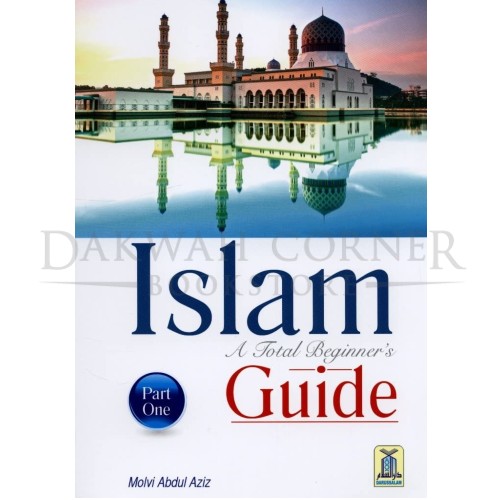
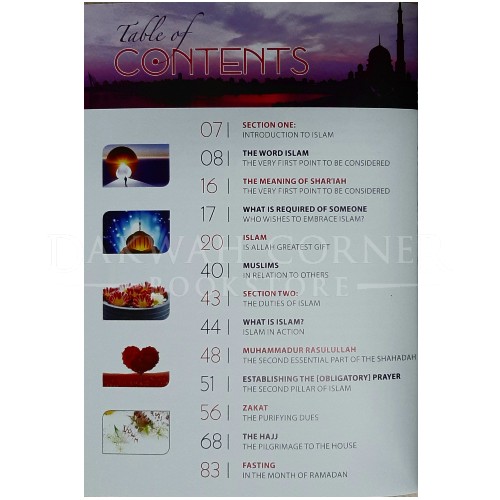
Islam A Total Beginners Guide – Part Two (P/B)
Highlights:
In present era we are facing lot of questions:
• What is status of women in Islam?
• Who is superior – man or women?
• What does Islam say about inter-religious marriages, man’s treatment towards his wife and privacy in homes?
• What does Islam say about dress, veil, clothing and ornaments, perfumes and the wisdom of banning gold and silk for men?
This beginner’s guide to Islam answers all such questions.
RM35.00



Polygamy in Islam (P/B)
Highlights:
Polygamy is the Muslim practice most frequently and severely maligned by Westerners and modernist Muslims. This book can be read with profit by all unprejudiced readers who wish to know its justification and rationale.
One of the greatest contrasts between Islam and the West is their conflicting concepts of relations between the sexes. Indeed, the very first question a Muslim convert is confronted with by an American or European is ‘Why does Islam allow four wives?’ This book…replies straightforwardly to that question and much more.
The authors describe all the most important characteristics of marriage in Islam, pointing out that the Western notions of sex equality and romantic premarital ‘love’ are not necessary in Islamic marriage based on piety and the commitment on the part of both parents to win the pleasure of Almighty Allah.’
This book contains basic guides for anyone interested in understanding the rights and obligations of males and females in Islamic plural marriage. The guidelines have been drawn from the Quran, Hadith and opinions of Islamic scholars.
RM20.00

Prophet Muhammad: A Blessing for Mankind
Highlights:
Prophet Muhammad (blessings and peace of Allah be upon him) and the lessons he taught us from the continued hardships he underwent in every stage of his life are a real blessing for humankind. Being an orphan child made him compassionate to widows and orphans as well as to the poor. His multiple marriages strengthened the ties of kinship amongst the different tribes, dissolving long-standing enmity. His message and prophethood were challenged by the polytheistic society in Makkah, forcing him and his few followers to emigrate to Madinah. Despite his illiteracy and the struggles he faced, he conveyed Allah’s Book, the Noble Qur’an, to all humanity, teaching them the values and principles that are presently adopted by billions of Muslims throughout the world. In the Qur’an, Allah, the Almighty addresses the Prophet (blessings and peace of Allah be upon him), saying: {We have sent you only as a mercy to the worlds.} (Qur’an 21: 107)
RM8.00 RM9.00

Wholeness and Holiness in Education An Islamic Perspective (P/B)
Highlights:
It was initially an adaptation of Shah ‘Abdul Qadir Muhaddith Dehlawi’s translation and commentary known as Mudih al-Qur’an which according to many great ‘ulama’ is devinely inspired and accepted by all Muslims.
RM62.00
Recently Viewed

Summarized Sahih Al Bukhari – Large Size
Highlights:
Sahih Al-Bukhari covers almost all aspects of life in providing proper guidance from the messenger of Allah. Translated into English in a very easy & simple language, so that all readers can understand it without difficulty. All Muslim Scholars agree that Sahih Al-Bukhari is the most authentic book after the Qur’an. The Summarized Bukhari is condensed into about 1000 pages by selecting a few Hadith from the original 9-Volume which has about 4000 pages. This book contains about 2220 Hadith.
RM100.00

The Right to Education, Work and Welfare in Islam (P/B)
Highlights:
In The Right to Education, Work and Welfare in Islam Professor M.H. Kamali develops an Islamic perspective on three connected and complementary areas of rights and liberties. He urges that education is often a necessary ingredient of professional work even more so now than in earlier times when the range and variety of specialised knowledge were relatively limited. A person who acquires education, whether generally or at advanced levels of specialisation, is more likely to stand in a better position to enter the workforce and thus to contribute to the welfare of the community.
The author commences his discussions on education, work and welfare in Islam by focusing on how each is treated in the Qur’an; and follows this by the example of the Prophet and, after him, the Pious Caliphs who gave prominence to the education and welfare needs of people at times both of scarcity and affluence. Professor Kamali then moves forward to our time and discusses the right to education, the education of children, institutionalisation of learning, academic freedom and the debate between science and religion.
The section on work elaborates on the value of work, work ethics, workers’ and employers’ rights and responsibilities, and the role and responsibility of governments.
Finally, the section on welfare focuses on the importance in Islam of caring for those who are in need and the different forms of provision that can be made available by individuals, the state and charities.
RM63.00

When Muslim Teens Rebel (Causes & Solutions)
Highlights:
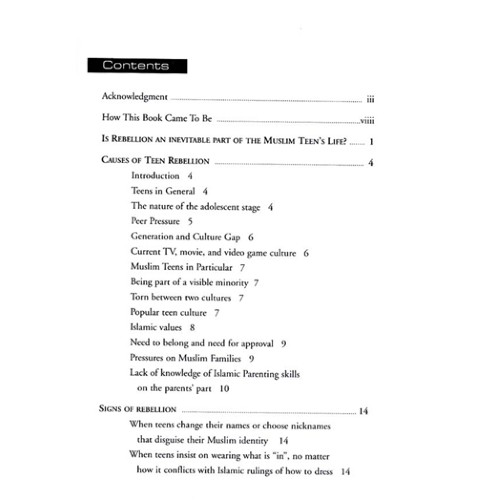
The objective of the book is to help parents save their teens from the negative impact of popular teen culture and succeed in raising them as strong, confident personalities who can contribute positively to their community and to the North American society at large. The book starts by explaining what is meant by rebellion, and discussing if it is inevitable in the life of a Muslim Teen. It then covers three basic ideas. The first idea deals with the causes of teen rebellion in general and additional factors that contribute to Muslim teen rebellion in particular. The second main idea covers the signs of this rebellion and how it manifests itself in the behaviour of our teens. The third and most important part of the book deals with a comprehensive solution consisting of three components, the most significant of which is the Prophet s SAAW example in dealing with youth, then the role that parents can play complemented with the community s involvement. The proposed comprehensive solution cited in this book will be of great benefit to various communities in general and to Muslim teens and youth in particular.
RM60.00


Principles of Islamic Jurisprudence (2nd Revised Edition)
Highlights:
This book offers a detailed presentation of the theory of Muslim law (usul al-figh). Often regarded as the most sophisticated of the traditional Islamic disciplines, Muslim jurisprudence is concerned with the way in which the rituals and laws of religion are derived from the Qur’an and the Sunna – the precedent of the Prophet. Revelation, which is given to man to restore unity and help him achieve a just and devout order in society as well as in the soul, must be interpreted so as to render it practicable in every culture, while not betraying its spirit and immutable provisions. To achieve this, additional sources of legal authority are recognized, including consensus (ijma), analogical deduction (qiyas), public interest (maslaha) and local customary precedent (urf). In employing these, the jurist guards the five principles which it is the purpose of Islamic law to uphold, namely, the right to life, sound mind, property, lineage and religion.
RM75.00
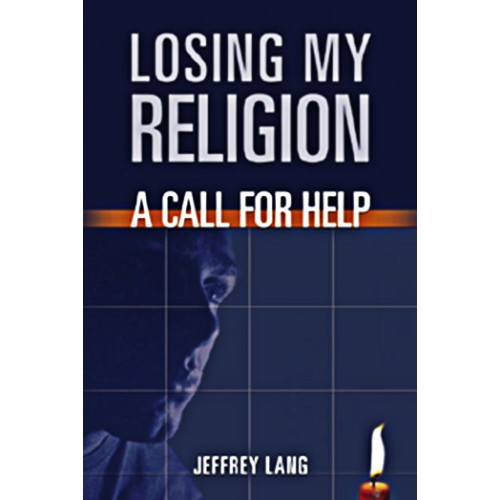
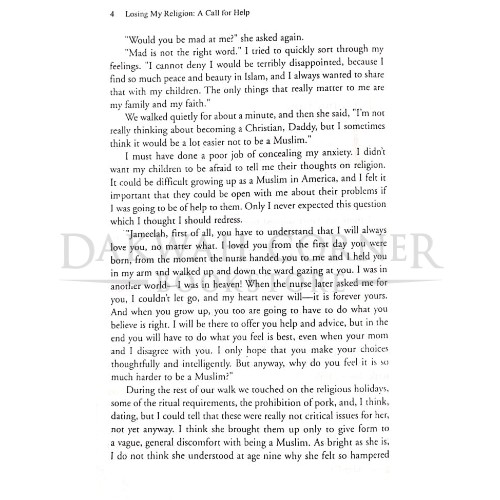
Losing My Religion: A Call For Help (P/B)
Highlights:
“Crucial to the vitality of any religious community is its ability to attract and engage descendants and converts. By this measure, notwithstanding the proliferation of mosques and Islamic organizations, the Muslim community in America is not doing at all well.” This rather sober assessment motivates Dr. Lang to address, in this book, the alienation from the Mosque of the great majority of America’s homegrown Muslims. In Losing My Religion: A Call For Help, the author comes to terms with many of the queries put to him by Americans of Muslim parentage and converts to Islam since the publication of his book Even Angels Ask in 1977. Lang asserts that to effectively respond to the general malaise of American-born Muslims, the Islamic establishment in America needs to be willing to listen to the doubts and complaints of the disaffected. This entails engaging in open discussions on issues with which many in the Muslim community will be uncomfortable, but Lang avers that such open dialogue will be of more benefit to young American Muslims struggling with their faiths than the covert and uniformed discussions that often take place or no discussion at all. For this reason, Lang feels it is important and beneficial “to be candid and objective and not evade controversy, for to inadequately state the case for or against a specific position, especially when it challenges convention, only serves to further alienate the sceptical.” In addition to examining questions of theodicy, hadith authenticity, and moot practices within the American Muslim community, the author includes many testimonials and inquiries that make this book informative. Dr. Lang is Professor of Mathematics at The University of Kansas, Lawrence, Kansas. He is the author of two best selling works: Struggling to Surrender and Even Angels Ask: A Journey to Islam in America. Both books have been translated into other languages.
RM115.00
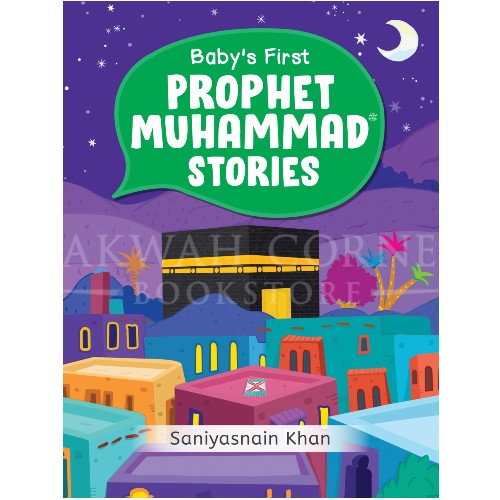
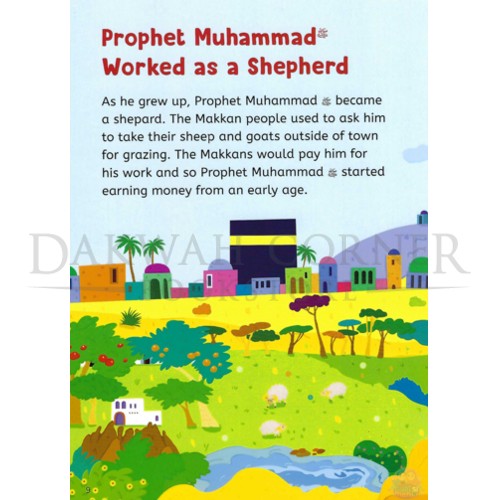
Baby’s First Prophet Muhammad Stories (H/B)
Highlights:
Baby’s First Prophet Muhammad Stories is a wonderful way to introduce your little ones to some of the best loved stories from the life of the Prophet Muhammad. These 20 easy-to-read stories, each accompanied with morals or prayers, are brought beautifully to life with bright, colourful illustrations, making the life of the Prophet more meaningful to young minds.
RM60.00
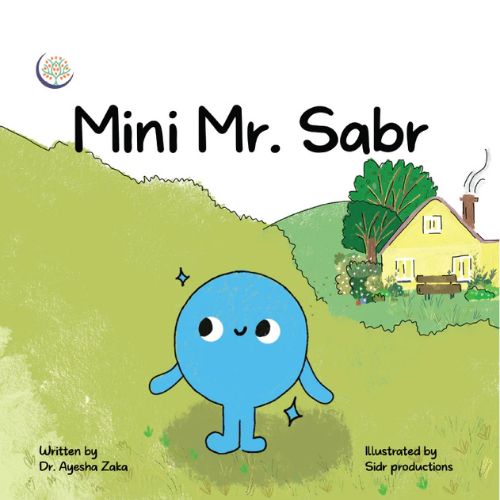
Mini Mr Sabr (P/B)
Highlights:
Mini Mr. Sabr is a gentle and engaging children’s story that introduces young readers to the beautiful Islamic value of patience (sabr) through simple language and relatable everyday moments.
RM20.00 RM35.00
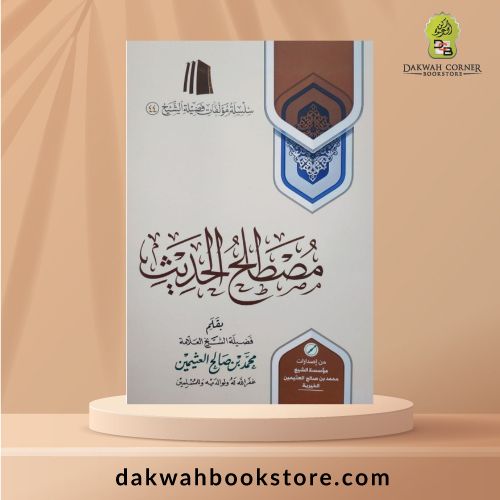
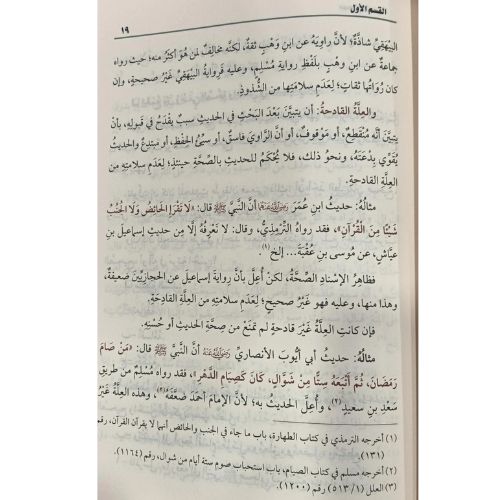
[AUH] Mustalah Al-Hadith / مصطلح الحديث
Highlights:
"مصطلح الحديث" كتابٌ للعلامة الشيخ محمد بن صالح العثيمين، يتناول فيه علم الحديث بالتفصيل، ويتناول مصطلحاته وتصنيفاته، وأنواع رواة الحديث وسيرهم، وأصول التحقق من صحة الحديث.
RM21.00


Hajj & Umrah (Pocket Guide) – English Version
5 ★
5 ★
2 Ratings
5 ★
2
4 ★
0
3 ★
0
2 ★
0
1 ★
0
Highlights:
A useful pocket guide that includes the rites of Umrah,Hajj, and visiting Madinah.
RM14.00
There are no reviews yet.