

| Weight | 0.70 kg |
|---|---|
| Dimensions | 23.5 × 16 × 2.7 cm |
| Author | |
| Binding | Hardcover |
| ISBN | 9789671378908 |
| Pages | 322 |
| Year of publication | 2016 |
| Publisher | Amanie Media Sdn Bhd |
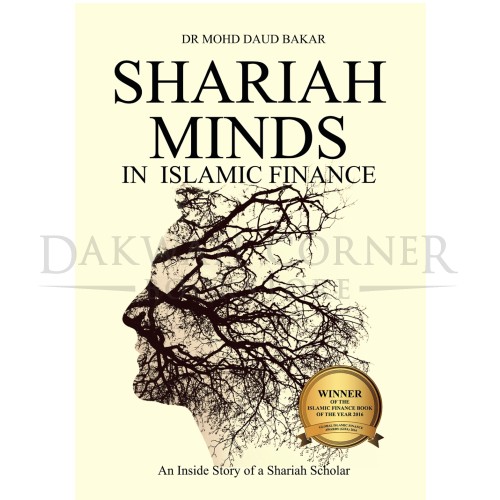
Shariah Minds In Islamic Finance
RM70.00
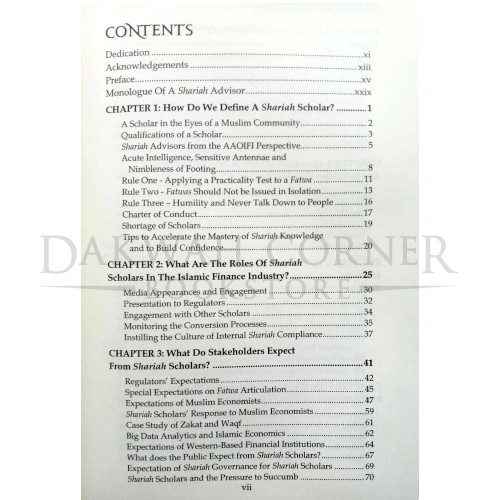
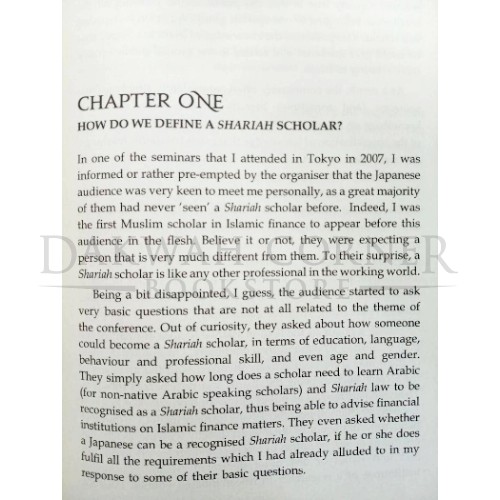
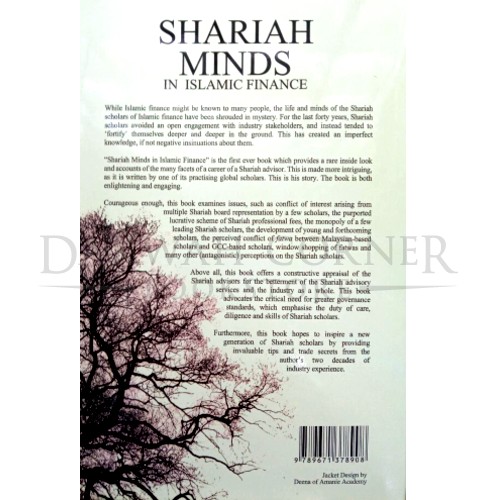
This book won the “Islamic Finance Book of the Year 2016”, awarded by Global Islamic Finance Award (GIFA) 2016. While Islamic finance might be known to many people, the life and minds of the Shariah scholars of Islamic finance have been shrouded in mystery. For the last forty years, Shariah scholars avoided an open engagement with industry stakeholders, and instead tended to ‘fortify’ themselves deeper and deeper in the ground. This has created an imperfect knowledge, if not negative insinuations about them. “Shariah Minds in Islamic Finance” is the first ever book which provides a rare inside look and accounts of the many facets of a career of a Shariah advisor. This is made more intriguing, as it is written by one of its practising global scholars. This is his story. The book is both enlightening and engaging. Courageous enough, this book examines issues, such as conflict of interest arising from multiple Shariah board representation by a few scholars, the purported lucrative scheme of Shariah professional fees, the monopoly of a few leading Shariah scholars, the development of young and forthcoming scholars, the perceived conflict between Malaysian-based scholars and GCC-based scholars, window shopping of fatwas and many other (antagonistic) perceptions on the Shariah scholars. Above all, this book offers a constructive appraisal of the Shariah advisors for the betterment of the Shariah advisory services and the industry as a whole. This book advocates the critical need for greater governance standards, which emphasise the duty of care, diligence and skills of Shariah scholars. Furthermore, this book hopes to inspire a new generation of Shariah scholars by providing invaluable tips and trade secrets from the authors’ two decades of industry experience.
Be the first to review “Shariah Minds In Islamic Finance” Cancel reply
You must be logged in to post a review.
Related Products
Forensic Psychiatry In Islamic Jurisprudence (P/B) (IBT)
This is the first book in Forensic Psychiatry that focuses on the application of psychiatry to legal issues connected to Islamic jurisprudence. It gives contemporary psychiatry in any Islamic country a broad spectrum of tools to work with, enabling the utilization of options specific to particular societal and cultural norms. This book will appeal to both the general as well as the academic reader.
War and Peace in Islam : The Uses and Abuses of Jihad (P/B)
Written by a number of Islamic religious authorities and Muslim scholars, this work presents the views and teachings of mainstream Sunni and Shi’i Islam on the subject of jihad. It authoritatively presents jihad as it is understood by the majority of the world’s 1.7 billion Muslims in the world today, and supports this understanding with extensive detail and scholarship. No word in English evokes more fear and misunderstanding than “jihad.” To date the books that have appeared on the subject in English by Western scholars have been either openly partisan and polemical or subtly traumatized by so many acts and images of terrorism in the name of jihad and by the historical memory of nearly 1,400 years of confrontation between Islam and Christianity. Though jihad is the central concern of War and Peace in Islam: The Uses and Abuses of Jihad, the range of the essays is not confined exclusively to the study of jihad. The work is divided into three parts: War and Its Practice, Peace and Its Practice, and Beyond Peace: The Practice of Forbearance, Mercy, Compassion and Love. The book aims to reveal the real meaning of jihad and to rectify many of the misunderstandings that surround both it and Islam’s relation with the “Other.”
Reviews:
“A dynamic myth-busting clarification of the real position of mainstream orthodox Islam on the whole question of violence and jihad.” —T. J. Winter, University of Cambridge
“This is the best book on the subject in English. It will be of inestimable value.” —Shaykh Mustafa Ceric, Grand Mufti Emeritus of Bosnia
Fiqh According To The Quran & Sunnah (2 vol)
The complete set, ‘Al-Lubab Fee Fiqh As-Sunnah Wal-Kitab,’ contains all of the books of Islamic Fiqh and its chapters, accompanied by evidence and is presented in a clear and simple manner, in order that they may be understood by the young and the old, without blindly following any of the schools of Jurisprudence, but rather being subject to authentic proofs and following the most authoritative opinions, without fanatical adherence to any particular group. Rather the author agrees with each group when the truth is with them and contradicts them when they veer from that which is correct.
Fiqh is to achieve access to knowledge of that which is unclear through knowledge of that which is proven, so it is more specific than mere knowledge or learning. And fiqh is knowledge of the juristic law. It is said Faquha -A man has acquired understanding and so he has become a Faqeeh (A scholar of Islamic Jurisprudence); and it is said Faqiha – He has understood it, i.e he has attained understanding of it, and it is said Tafaqqaha – he has devoted himself to the acquisition of (Islamic) Knowledge and specialized in it. Fiqh has been a subject of contention among the scholars as well as layman throughout the history of Islam.
The Right to Education, Work and Welfare in Islam (P/B)
In The Right to Education, Work and Welfare in Islam Professor M.H. Kamali develops an Islamic perspective on three connected and complementary areas of rights and liberties. He urges that education is often a necessary ingredient of professional work even more so now than in earlier times when the range and variety of specialised knowledge were relatively limited. A person who acquires education, whether generally or at advanced levels of specialisation, is more likely to stand in a better position to enter the workforce and thus to contribute to the welfare of the community.
The author commences his discussions on education, work and welfare in Islam by focusing on how each is treated in the Qur’an; and follows this by the example of the Prophet and, after him, the Pious Caliphs who gave prominence to the education and welfare needs of people at times both of scarcity and affluence. Professor Kamali then moves forward to our time and discusses the right to education, the education of children, institutionalisation of learning, academic freedom and the debate between science and religion.
The section on work elaborates on the value of work, work ethics, workers’ and employers’ rights and responsibilities, and the role and responsibility of governments.
Finally, the section on welfare focuses on the importance in Islam of caring for those who are in need and the different forms of provision that can be made available by individuals, the state and charities.
Hajj & Umrah And Visitors (H/B)
Rites and Selected Etiquettes for those intending to Perfom Hajj & Umrah and Visitors In this book the author calls attention to the most important things that those who intend to perform Hajj, Umrah or Visiting the Prophets Mosque in Medinah must have as provisions. The author has made his work brief and arranged its topics according to their priorities. the author mentions a considerable number of sayings of the people of knowledge and calling the attention of the reader to some important matters.
Al-Jumu’ah: The Day of Congregation
In our busy lives, Friday comes around once a week. It often comes and goes without our being really aware of it. For many Muslim men, it may be punctuated by the congregational prayer that they make special efforts to attend. For many Muslim women, it may go by just like any other day. This ought not to be the case. In this unique book, Dr. Gowher Yusuf gives us reason to stop and think about how special Friday (al-Jumu‘ah) really is, and what we should be doing to achieve the many bounteous blessings it holds for those who observe it. Drawing constantly from the Qur`an and the Sunnah and the great works of the scholars of Islam, Dr. Gowher Yusuf explores this topic in depth and presents it to the reader in simple language for them to understand and ponder over. This book travels through the various issues pertaining to the Friday prayer and its Khutbah, or sermon. These issues are explained within the Islamic framework, thus abolishing any myths and misunderstandings and clarifying the topic for the reader. Dr. Yusuf writes: The day of the week known as al-Jumu‘ah, or simply Jumu‘ah, is Friday, and it is special. Compared to the other days of the week, Friday has been accorded the largest amount of merit, so much so that the father of all humankind, Prophet Âdam (peace be upon him), was created on this day and a particular prayer was ordered for this day. It was from the guidance given to Prophet Muhammad (blessings and peace of Allah be upon him) to magnify this day, honour it, and designate it for acts of worship. …On a Friday, we all will be gathered and will stand congregated in front of Allah, the Exalted, on the Day of Resurrection, also called the Day of Accountability or the Day of Judgement.
Ibn Ashur Treatise on Maqasid al-Shariah (P/B)
Ibn Khaldun, the fourteenth century Arab historiographer and historian, is viewed as a founder of modern historiography, sociology and economics. He lived during a turbulent part of history, and out of his experiences, he ?conceived and created a philosophy of history that was undoubtedly the greatest work ever created by a man of intelligence…?. This work tells of the period of unrest in Ibn Khaldun?s life marked by political rivalries. It is during this turbulent period which provided him with the opportunity to write the Muqaddimah (or Prolegomena), earning him an immortal place among historians, sociologists and philosophe
The Concise Presentation of the Fiqh of the Sunnah and the Noble Book
Written by Dr. Abdul-Azeem Badawi and translated by Jamal al-Din M. Zarabozo, The Concise Presentation of the Fiqh of the Sunnah and the Noble Book covers the fiqh of diverse topics like purity, prayer, fasting, zakah, pilgrimage, marriage, business transactions, foods, inheritance, criminal offenses, and jihad. Dr. Badawi relies only on the Quran and the Sunnah, making it an authentic Islamic book on fiqh and a collection of sound hadiths.
Shatibi’s Philosophy of Islamic Law (P/B)
Abu Ishaq al-Shatibi, who died in 1888, had sought an answer to the challenge posed by modernisation and change to Islamic law, by introducing maslahah, which forms the basis of his philosophy of Islamic law. In a fascinating way, the author leads us step by step to what he considers the true import of Shatibi’s views concerning jurisprudence.
A Guide to Male-Female Interaction
Are Muslim men allowed to interact with female students, and vice versa, in a virtual classroom? Can a Muslim woman pursue a professional career that necessitates her interaction with men? Is it appropriate for a woman to serve her husband’s guests? Do mixed wedding ceremonies comply with the Sharia? Read this bilingual book to find the answers and more!
Fast According to the Quran & Sunnah
Saum (Fast) is a third Pillar of Islam. Allah’s Messenger said, Allah says: “Every deed of the son of Adam is for him, except Saum (fasting). It is for Me and I shall reward for it.”
As the status of this act of worship is so high it is essential to learn the pilings pertaining to this month of fasting so that Muslims will know what is obligatory in order to do it, what is forbidden to avoid it, and what is permissible so that they do not unnecessarily subject themselves to any hardship by depriving themselves from it.
This book consists of all the main issues of Fast. The main objective of this work is to serve an easy and authentic reference to the reader.
Fiqh Course: Tahaarah, Salaah & Janaa’iz
This course was compiled for English-speaking Muslims and is especially beneficial for new Muslims. It covers tahârah (purification), salâh (prayer) and janâ‘iz (funerals). It is set out in an easy-to-understand manner, citing evidence from the Qur’an and authentic hadiths. The aim of this book is to provide the reader with a correct, yet uncomplicated guide to the performance of the aforementioned acts of worship. Allah willing, it is the first in a series which will cover all aspects of worship and Islamic jurisprudence.
Recently Viewed
Aziz and the Golden Age – Activity Kit
An activity Kit is free to download. You can purchase a physical book HERE without this activity kit.
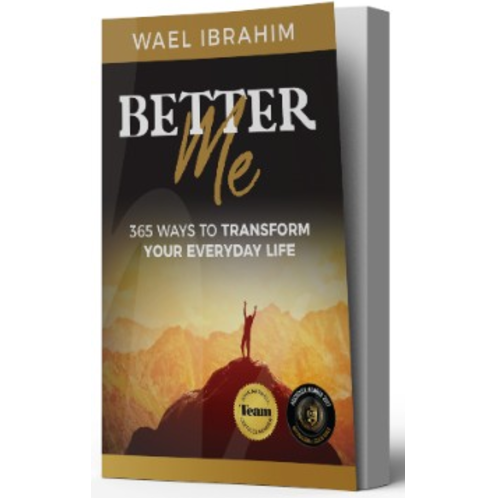
Better Me : 365 Ways to Transform Your Everyday Life
Let Us Remember Allah And Praise Him
Remembrance, praise and supplication – dhikr and du‘â’ – are the core of worship of the Divine. The Noble Qur’an and the last Prophet (blessings and peace of Allah be upon him) have stressed this point and taught us how to attain Allah’s pleasure through calling on Him and remembering Him in words of praise and thankfulness. This small book is a valuable collection of daily supplications from the Qur’an and the authentic hadiths. It contains the Arabic text, full transliteration and clear translation of the meaning of dozens of phrases of remembrance (dhikr) and supplication (du‘â’). This new and revised edition of Let Us Remember Allah and Praise Him is designed to be easy to use: its full-sized page format ensures that the print is large enough to read effortlessly, and yet its ultra-slim volume makes it no trouble to slip into a handbag
or backpack. It is truly a practical handbook for every Muslim desiring to seek peace in this earthly life and salvation in the hereafter.
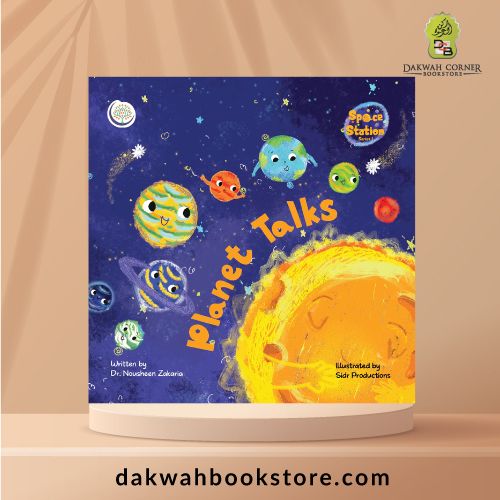
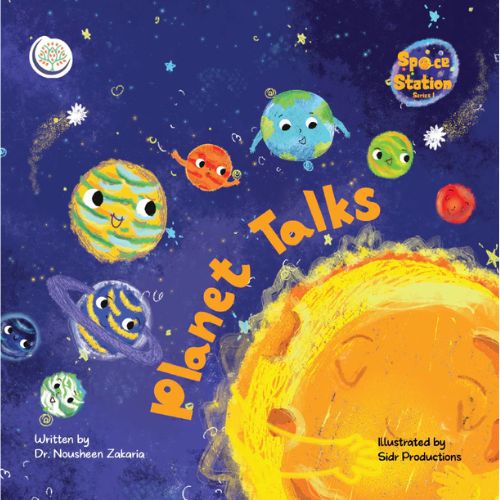
Planet Talks (P/B)
What if the planets could talk?
High above the Earth, beyond clouds and stars, the planets gather for a quiet conversation. Some are hot. Some are icy. Some spin fast, others slowly.
Each one has a story to tell.
What makes Earth so special?
Why does Mars hold secrets of ancient water?
Planet Talks is a gentle journey through space where science meets wonder, and every planet becomes a sign to reflect upon.
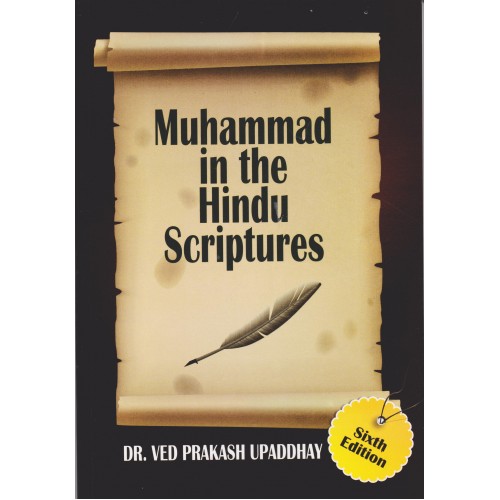
Muhammad in the Hindu Scriptures (P/B)
God is One. Human nature is one. Human destiny is one. And God�s message to humanity vis-a-vis that destiny is one. However, the rebellious element in man�s nature has led him to disobey God on the one hand, and on the other, he has pushed on to distort the very message of God. But the message is never fully lost. It would be ludicrous and indeed heretical to think that the situation could have gone out of God’s control.
With every distortion, therefore, He has renewed the message to salvage humanity from self-ruin. More interesting than that is the fact
that He has inserted in every message a Pointer to the Final Guide and the message he would be entrusted with; a Pointer which shows the true
seeker where the uncorrupted message could be found – the message that no one would be able to distort any more. While the main body of the message has been corrupted, the Pointer contained within has not been destroyed. Muhammad in the Hindu Scriptures brings out the truth of this phenomenon.
In addition to the Vedas and the Puranas, the book has unearthed this Pointer in the Buddhist, Christian, Jewish and other Hindu scriptures. Each of these scriptures uses its own unique Pointer relevant to its own theological scheme and the religious mentality of its own people. Separately and jointly these Pointers lit up the road to Muhammad (blessings and peace be upon him) exclusively, without any iota of doubt.
By all accounts the Final Guru has been sent and the Last Testament is in our laps. Additionally, the existence of these Pointers in the earlier
scriptures is yet another dimension of God’s mechanism to guide mankind to the infallible Truth. Upon reading the book, the theist, the atheist and the agnostic will find a lot to think about.
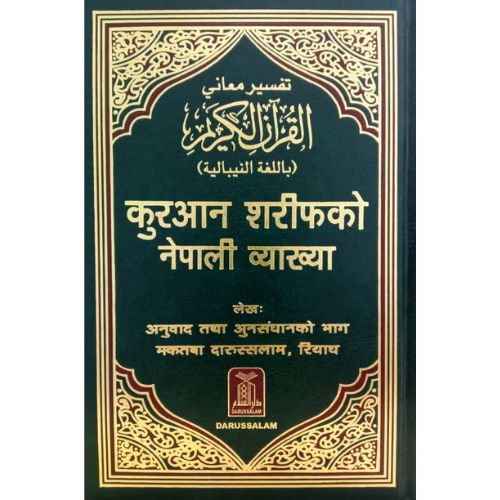
Qur’an Nepali Translation
Quran in Nepali Language ( Arabic To Nepali Translation)
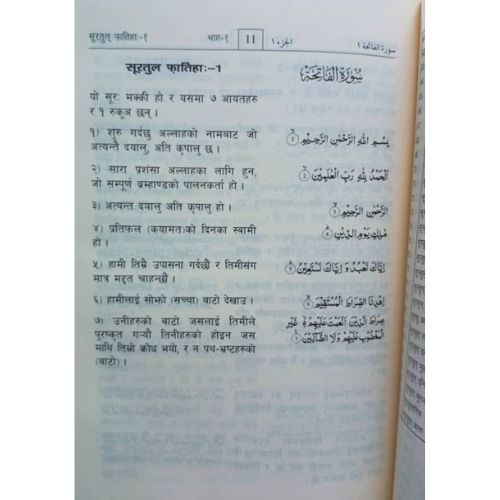
The Noble Quran was Translated into Nepali with Arabic script included.
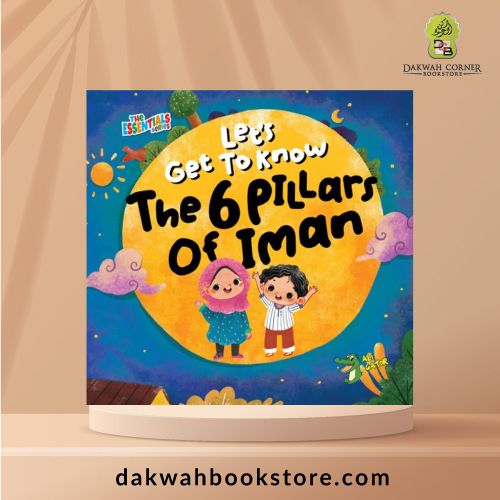
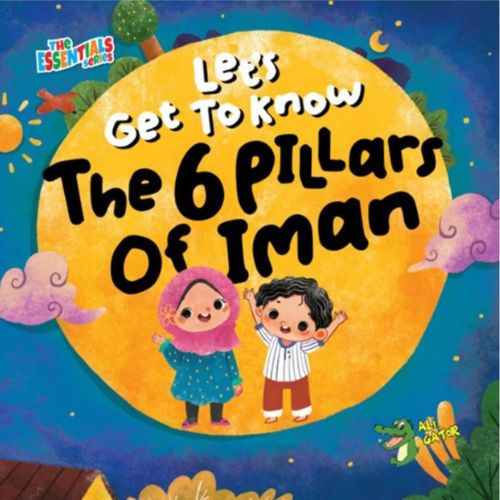
The Essential Series: Let’s Get to Know the 6 Pillars of Iman
Join Suhail and Summayah as they explore the foundational beliefs that strengthen Islamic faith.
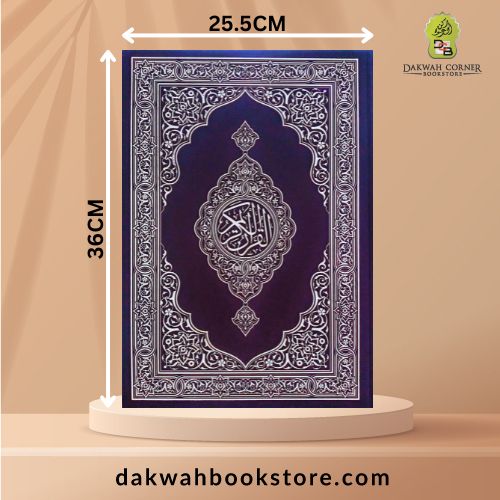
Mushaf Madinah (Brown) (36cmX25cm)
Large size with brown colour Mushaf printed by Majamma Malik Fahad and found in Haram Makkah, Madinah and many Masaajid around the world. Deluxe hardbound with fine paper and brown background.
Read Qaidah (Madinah Script)
Easy progress through bitesize lessons
Read takes children step by step through letters, vowels, words and more until they’re ready for the Quran. Each line forms an easy, manageable lesson so children build momentum and progress.
- Motivational stickers
-
NOT Kiitab Compatible


There are no reviews yet.