



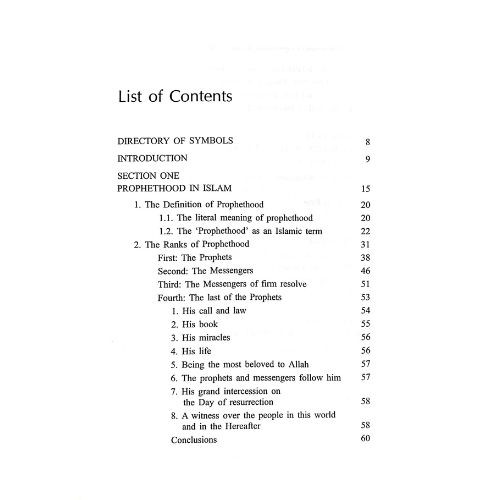
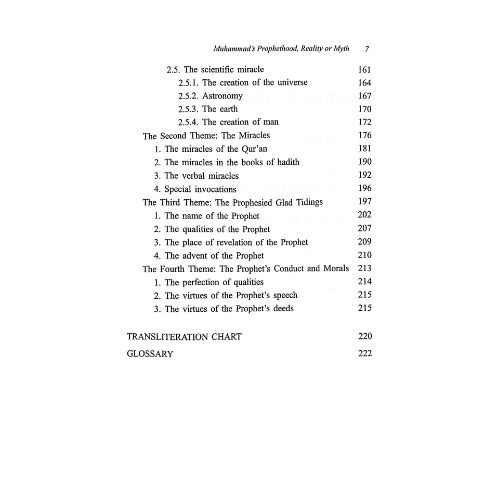
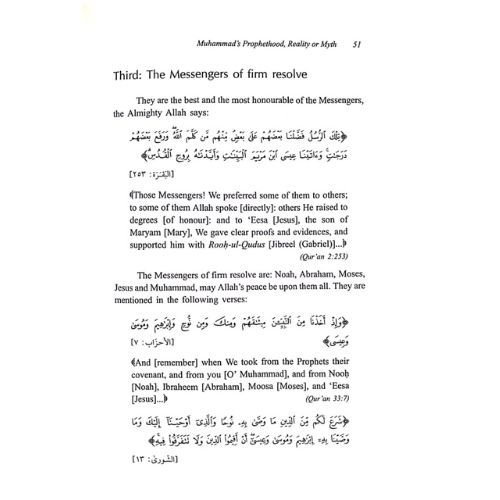
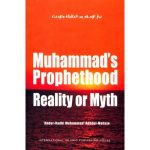
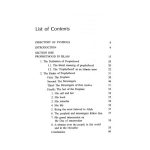
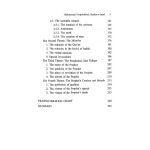
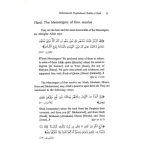
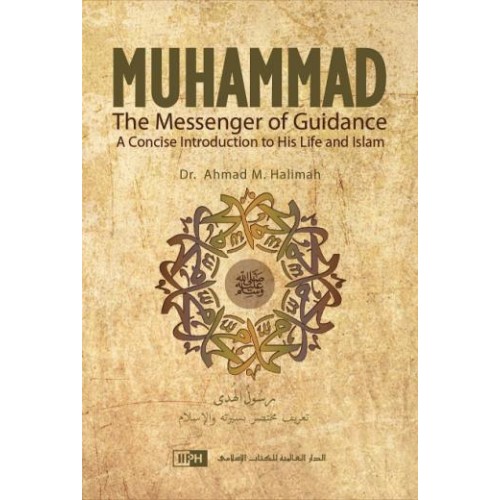

No other personality in history has generated more debate than that of the Prophet of Islam, Muhammad. He’s been ranked the number one most influential man in human history. Not by a Muslim, but by a Westerner. Was he a Prophet or an imposter? Did Moses really tell of his coming? Did Jesus order future generations to follow him? Does the Bible describe him and his message? If you have been contemplating these questions, you will find answers in this book. It will shock you, soothe you, make you cry, but most of all it will educate you. Ignorance begets fear, and fear begets hate. This book is a bridge over a gap widened by recent world events and the negative media coverage of them. If you seek the truth, if you can handle the truth, you will find it in this book.
Muhammad’s Prophethood Reality or Myth
RM38.00
Frequently Bought Together
| Weight | 0.39 kg |
|---|---|
| Dimensions | 16 × 21 × 2 cm |
| Product Type | Book |
| Author | |
| Publisher | IIPH |
| Pages | 224 |
| ISBN | 9789960501109 |
Be the first to review “Muhammad’s Prophethood Reality or Myth” Cancel reply
You must be logged in to post a review.
Related Products

Muslim Unification at Time of Crisis
This book authored by one of the great scholars of our time is an advice to the people of Ahulul ?Sunnah wal-Jamaah to unify and be merciful to each other, and cooperate upon righteousness and taqwa.


Provisions of the Afterlife Which Lie Within Prophetic Guidance (H/B – DKI
Written originally by Ibn Qayyim Al-Jauziyyah is one of the important resources of knowledge for those who seek to know the Seerah of their Prophet (P.B.U.H) as well as the Fiqh learned from it. This is a book that is unique in that it explains the Sunnah through the Seerah and the Seerah through the Sunnah. It is a profound classic work containing thousands of pages written by Imam ibn al-Qayyam while on the Hajj journey, Pilgrimage, from Damascus to Makkah. Despite its being written from memory, the several thousand incidents, Hadiths, Ayat (verses of the Quran), Fiqh benefits, as well as names of the companions associated with them, were remarkably close to the truth with marginal errors.
However, those who know the status, level of knowledge ad Ta’hqiq that Imam ibn al-Qayyim had will not be surprised to know this fact. Still, it is amazing how Ibn Al-Qayyim was able to write this vast volume while traveling to Hajj (Pilgrimage), especially since he was away from the resources of knowledge and was enduring the hardships of travel. It is a blessing from Allah (S.A.T) that it was possible for him to do so. Note: As with Many English Translations this work appears to be slightly abridged but it seems to cover most of the subjects Note : With the Lack of English works covering Hanbali Fiqh , This Books would be the nearest alternative. Although not a Specifically Fiqh Book, Ibn Qayyim’s views which are based on Hanbali Fiqh are quoted throughout.

New Directions in Islamic Education : Pedagogy and Identity Formation (P/B)
New Directions in Islamic Education explores the relationship between pedagogy and the formation of religious identities within Islamic education settings that are based in minority and majority Muslim contexts. Based on empirical research, the book engages critically with the philosophical, theological and cultural dynamics that inform Muslim educational thought and practice. The book offers an integrated model of Islamic education that identifies the heart of the Islamic educational imagination as tarbiyah, a transformative process of becoming. Overall, this book seeks to ground the theory and practice of Islamic education within the experience of the educator and the learner, and it synthesises the spiritual foundations of Islam with the tradition of critical reflection within the classical Muslim educational heritage. This ground breaking and wide-ranging work should be of interest not only to Muslim educators and education specialists, but also to social scientists, theologians and policy makers.

Essential Lessons for Every Muslim
This work is a translation of Shaikh Abdul Aziz bin Baz’s book ‘Ad-Duroos Al-Muhimmah li-Ammatil-Ummah.’ It contains concise lessons that explain the fundamental teachings of Islam. This book covers a wide range of basic information such as the meaning of Tawhid (Islamic monotheism), the categories and implications of Shirk (polytheism), the regulations of prayer, and Islamic morals and manners. As the title implies, these are truly essential lessons for everyone who is concerned with the correctness of his Islamic beliefs and acts of worship.


Weakness of Faith (IIPH)
The phenomenon of weak faith has become very widespread among Muslims, and many people complain about the hardness of their hearts. So often we hear the words, “I feel hardness in my heart,” “I do not find any joy in worship,” “I feel that my faith has hit rock bottom,” “Reading Qur’aan does not move me,” “I fall into sin so easily.” The effects of this affliction can be seen in many people, and this problem is the cause of every disaster and adversity.
One of the most important principles which must be understood in order to treat the problem of weak faith is that faith increases and decreases, or waxes and wanes. This is one of the basic principles of the ‘aqeedah of Ahl al-Sunnah wa’l-Jamaa’ah, who say that faith is something to be spoken in words, to be believed in in the heart, and to be put into action. Faith increases with obedience and decreases with disobedience.
‘… that they may grow more in Faith along with their (present) Faith…’ [al-Fath 48:4]
‘… Which of you has had his faith increased by it? …'[al-Tawbah 9:124]. aari, Fath, 1/51).


A Guide to Salah (Prayer) (P/B)
This book is the result of direct research into the Sunnah of Prophet Muhammad saw and makes numerous references to the original sources. It contains all the essential details of salah without being too bulky or complicated, thus making it an ideal reference book either at home or while travelling.
A clear and concise explanation on how to pray. Also gives a detailed description of the preliminaries to salah, and different types of salah, with easy-to-follow illustrations.

Treatment of Magic, Evil Eye & Satan’s Touch (P/B)
A detailed treatise on the authentic treatments for afflictions of magic, evil eye and possession based on the Islamic teachings of the Qur’an and Sunnah of Muhammad.

Lawful Wives or Unlawful Girlfriends
In the Name of Allah, the Most Beneficent, the Most Merciful
Allah (SWT) says: (If you fear that you will not be able to deal justly with the orphans, marry women of your choice, two or three or four; but if you fear that you shall not be able to deal justly (with them), then only one or (the captives or the slaves) that your right hands possess. That will be more suitable to prevent you from doing injustice) (An-Nisa’: 3).
Praise be to Allah (SWT) who has prescribed for His Servants a religion (Islam) that is beneficial to them in this world and the Hereafter, and Peace and Blessing be upon His Messengers and Prophets who were guided by His Guidance and conveyed His Religion. The last and seal of His Messengers was Muhammad Ibn Abdillah (SAW). He (SAW) was the best to advise his Ummah and convey the True Message, by words, deeds and his character. He (SAW) was the best model and example for the believers.

Ibn Taymeeyah’s Essay on the Jinn (P/B) ASN
Dr. Abu Ameenah Bilal Philips has rendered Ibn Taymiyah’s treatise, Eedaah-ud-Dalaalah fee ‘Umoom-ir-Risaalah, from volume 19 of Majmoo‘-ul-Fataawa into very readable English. This abridged and annotated translation is significant in that it is perhaps the first book available in English exclusively on the topic of spirit-possession and exorcism in Islam.
Ahmad ibn ‘Abdul-Haleem ibn Taymeeyah was bron in the town of Harran [near Edessa, in what was once Northern Iraq, but is now called Orfa and is a part of Turkey.], in the year 1263 CE. His father was a leading scholar of the Hanbalite school of Islamic law and so was his grandfather, who authored Muntaqaa al-Akhbaar, the text of ash-Shawkaanee’s Hadeeth classic Nayl al-Awtaar.
Ibn Taymeeyah mastered the various disciplines of Islamic study at an early age and read extensively the books of the various sects and religions in existence at that time. Much of his time and effort was spend defending the orthodox Islamic position against a tidal wave of deviation which had swept over the Muslim nation. Consequently, he faced many difficulties from both the prominent sectarian scholars of his time and from the authorities who supported them. His clashes with them led to his imprisonment on numerous occasions. Ibn Taymeeyah also fought, not only against internal enemies of Islaam, but also against its external enemies by both his Fatwaas (Islamic legal rulings) and his physical participation in battles. His ruling allowing the taking up arms against groups which recognized the Shahaadataan (declaration of faith) but refused to uphold some aspects of the fundamental principles of Islaam, greatly affected the resistance movement against the Tartars who had declared their acceptance of Islaam but did not rule according to divine law.
During these struggles he wrote countless books and treatises demonstrating his extensive reading and knowledge, not only of the positions of the early scholars, but also those of the legal and theological schools which had subsequently evolved. Ibn Taymeeyah also had a major effect on the open-minded schoars of his day, most of whom were from the Shaafi’ite school of law. Among the most famous of his students were IBN KATHEER, ADH-DHAHABEE and IBN AL-QAYYIM. The author died in 1328 while in prison in Damascus for his Fatwaa against undertaking journeys to visit the graves of saints [Ibn Taymeeyah’s ruling was based on the authentic statement reported by Abu Hurayrah wherein the Prophet Muhammad (sallallaahu alayhi wasallam) said, “Do not undertake a journey except to three masjids; this masjid of mine, Masjid al-Haraam (Makkah) and Masjid al-Aqsaa (Bayt al-Maqdis).” Collected by Al-Bukhaaree and Muslim]. His Fatwaa had been distorted by his enemies to say that he forbade visiting the Prophet Muhammad’s (sallallaahu alayhi wasallam) grave.


A Treatise on Hijab and Compilation of Questions Pertaining to Family Matters (H/B)
No one denies that the modesty which is commanded by Islamic Law and by convention includes the decency and decorousness demanded of a woman, and the kind of behavior that will ensure that she is kept far away from situations of temptation and suspicion. Further more, there is no doubt that the greatest act of modesty that she can perform is to wear the hijab, which covers her face. It is the best thing with which she can adorn herself, because it protects her and keeps her far removed from temptation.

Fundamentals of Islam (P/B)
Fundamentals of Islam is a revised English edition of the critically acclaimed Khutubah (original written in Urdu). It consist of Friday congregational addresses, in them he expounds familiar themes; like Iman, Islam, the Prayer, Fasting, Alms-giving, Pilgrimage and Jihad.


Why Islam?
Often, the first thing someone is asked when they discover the truth and embrace Islam is the question: Why Islam? Here, an American revert-to-Islam answers that question. The author, K. Sherman, writes: The beauty of Islam is probably the best-kept secret in modern times; it is about time it was revealed. This is the sentiment of a majority of people who are discovering the truth about Islam every day. My first exposure to the religion was through a perusal of a fifty-page booklet titled Towards Understanding Islam (written in 1932). It explained to me everything that twenty years of life and fifteen years of education could not. After the initial sense of relief, I suddenly felt cheated. I was consumed with rage. Why? I could not fathom how people could know about this phenomenal way of life and not speak out and inform others. This book is my personal take on the beauty of Islam, backed up by relevant and authentic references. I am convinced that humanity direly needs it and it is my duty to speak out.
Recently Viewed
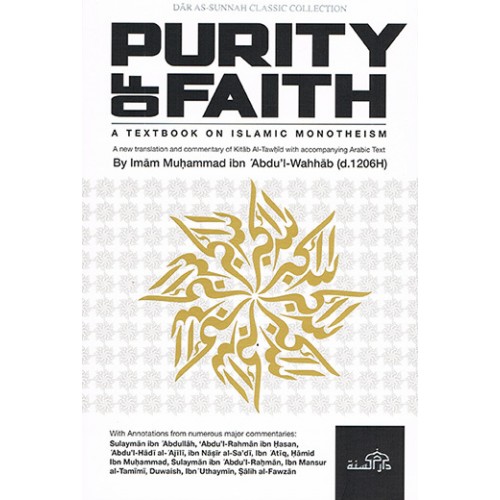
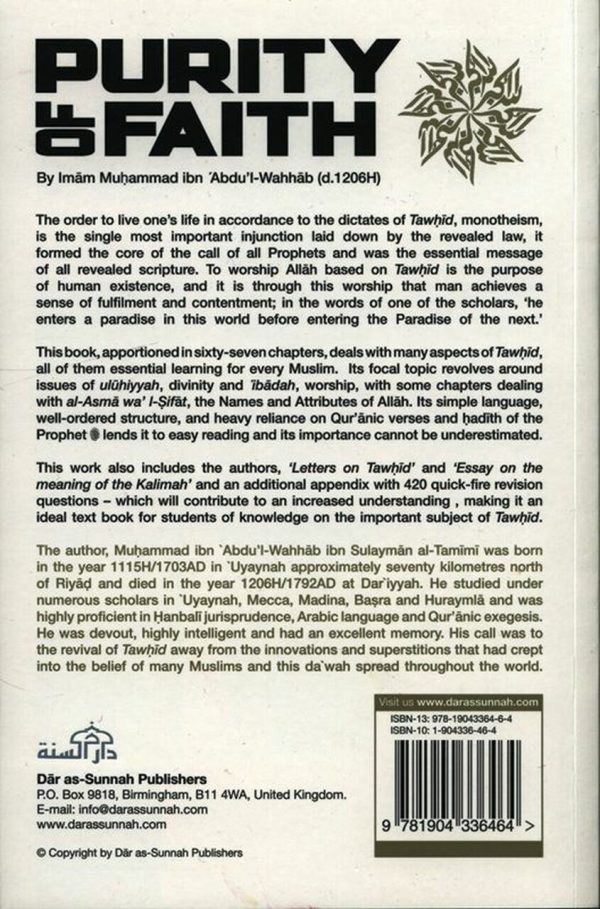
Purity of Faith (P/B)
The order to live one’s life in accordance to the dictates of Tawhid, monotheism, is the single most important injunction laid down by the revealed law, it formed the core of the call of all Prophets and was the essential message of all revealed scripture. To worship Allah based on Tawhid is the purpose of human existence, and it is through this worship that man achieves a sense of fulfilment and contentment; in the words of one of the scholars, ‘he enters a paradise in this world before entering the Paradise of the next.’
This book, apportioned in sixty-seven chapters, deals with many aspects of Tawhid, all of them essential learning for any Muslim. Its focal topic revolves around issues of ulùhiyyah, divinity and `ibadah, worship, with some chapters dealing with al-Asmm wa’l-Sifat, the Names and Attributes of Allah. Its simple language, well-ordered structure, and heavy reliance on Qur’anic verses and Hadith of the Prophet (saw) lends it to easy reading and its importance cannot be underestimated.
Kitab al-Tawhid is a landmark work analysing orthodox Islamic monotheism. Since it was authored it has received a great deal of attention, a large number of commentaries and has been translated into over twenty languages. Relevant as it was then, it remains relevant today and Muslims are in dire need of reading it, studying it and teaching it.
Unfortunately, despite previous laudable efforts, a translation does not yet exist in English that truly reflects the importance of this work. It gives Dar us-Sunnah great pleasure to present this work to the reader in the hope that it fills this gap
• An accurate translation in easy to read modern English
• Annotations taken from 15 major commentaries
• All major criticisms against the book by its antagonists addressed
• All Hadiths and narrations critically analysed and referenced
• This work also includes the authors ‘Letters on Tawhid and Eassay on the meaning of the Kalimah’
• Overview of the style and structure of the book
• Biography of the author analysing his life, creed and works
• The Arabic text of the whole book included
• 420 Revision Questions
• Indexes of verses, Hadiths and narrations
• This is an ideal text book for every Muslim on this very important topic
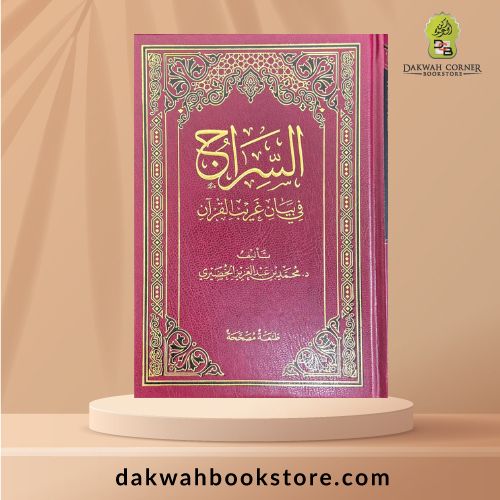
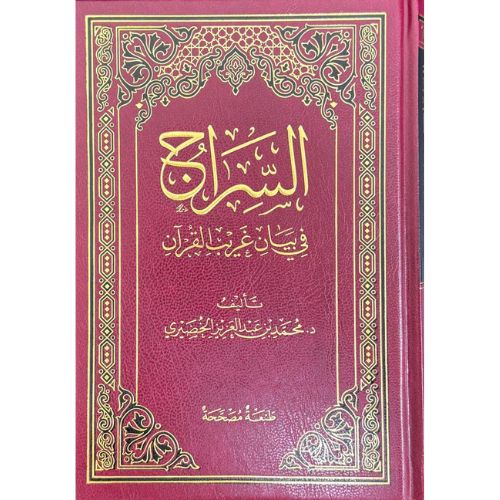
[AUQ]As-Siraj Fi Bayan Gharib Al-Qur’an/ السراج في بيان غريب القرآن
أما عبارة “بيان غريب القرآن” فهي توضّح موضوع الكتاب بدقة، حيث تشير إلى شرح الكلمات النادرة أو الصعبة في القرآن الكريم وبيان معانيها اللغوية. وهذا النوع من الكتب مهم لطلاب العلم والباحثين في اللغة العربية وعلوم القرآن، لأنه يساعد على فهم المفردات القرآنية التي قد تكون غير مألوفة.
وبشكل عام، فإن العنوان يجمع بين الأسلوب البلاغي الجذاب والدلالة العلمية الواضحة، مما يعكس هدف المؤلف في توضيح معاني الألفاظ الغريبة في القرآن الكريم وتسهيل فهمها للقارئ.

Let Us Be Muslims (P/B)
LET US BE MUSLIMS is a new edited English version of Sayyid Mawdudi’s Urdu Khutubat. It is no ordinary book, says Khurram Murad in his long Introduction, for it has stirred more hearts and impelled more lives to change their course than any of his more erudite works. In these Friday congregational addresses, Sayyid Mawdudi expounds such familiar themes as Iman, Islam, the Prayer, Fasting, Almsgiving, Pilgrimage and Jihad. But, in an unusually beautiful, powerfully reasoned, eloquent and passionate, and yet simple and lucid style,
“Sayyid Abul A’la Al-Mawdudui (1903-1979), one of the chief architects of contemporary Islamic resurgence, was the an outstanding Islamic thinker and writer of his time. He devoted his life to expound the meaning and message of Islam and to organise a collective movement to establish the Islamic Order. In this struggle, he had to pass through all kinds of sufferings.
Between 1948-67, he spent a total of five years in different prisons of Pakistan. In 1953, he was also sentenced to death by a Martial Law court for writing a ‘seditious’ pamphlet, this sentence being later commuted to life imprisonment. In 1941, he founded Jama’at-I Islami, of which he remained Amir, until 1972 and which is one of the most prominent Islamic movements of our day. He authored more than one hundred works on Islam, both scholarly and popular, and his writings have been translated into forty languages.”
My Arabic Alphabet Book
The Language of the Qur’an (Board Book) Ages 3 to 5
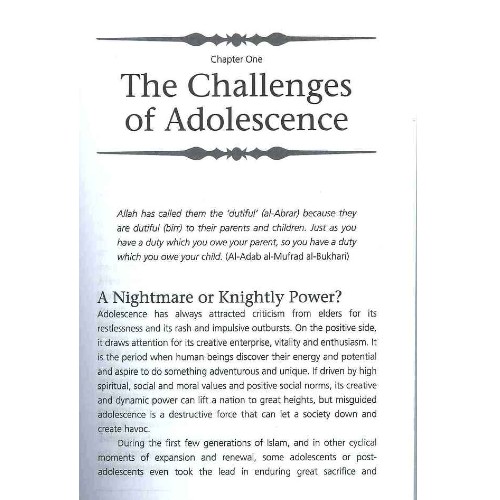
A Guide to Parenting in Islam: Addressing Adolescence
| Addressing Adolescence is a parent-to-parent handbook outlining how to tackle the challenges of parenting adolescents within an Islamic ethos in a pluralist society.
It covers: |
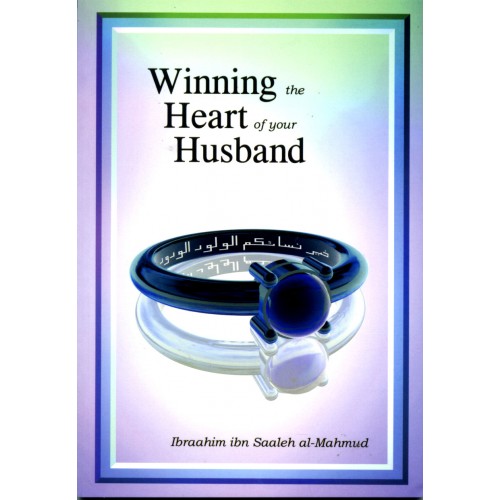
Winning the Heart of your Husband (P/B)
Table of Contents:
HOW TO WIN YOUR WIFE’S HEART ………………..5
INTRODUCTION …………………….5
HOW TO WIN YOUR WIFE’S HEART………………..6
TREATING WONAN WITH KINDNESS ………………..10
THE WIFE’S RIGHT ………………………………………12
RIGHTS COMMON TO HUSBAND AND WIFE …………15
THE CAUSES OF MARRIAGE PROBLEMS……………….16
THE EPIDEMIC OF SINS ……………………………………18
AN IMPORTANT FATWA …………………………………..20
THE EXUBERANT HUSBAND ………………………………22
IMPORATNT QUESTIONS …………………………………..23
A HUSBAND THREATENS WITH DIVORCE ………………27
A WIFE PLEADING WITH HER HUSBAND NOT TO TRAVEL………29
CONCLUSION………………………….32
A MESSAGE FROM THE PUBLISHER ……………..35
STORIES FROM THE PREDECESSORS ……………36
HOW THE COMPANIONS FEARED ALLAH………..50
EXHORTATION OF THE PREDECESSOR TO TAQWA………….58
THE QUALITIES OF THOSE WITH TAQWA………….61
ALI’S DESCRIPTION OF THOSE WITH TAQWA ……..61
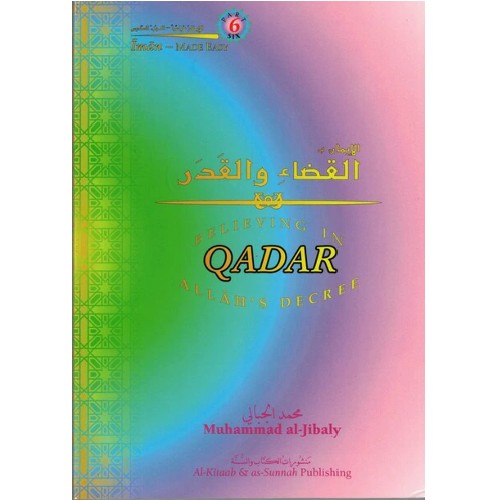
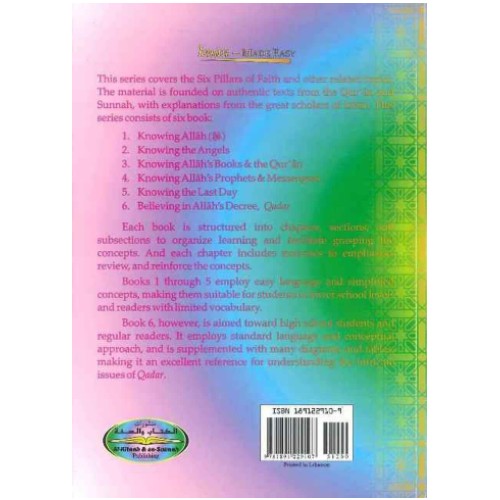
Believing In Allah’s Decree, Qadar (Eeman Made Easy Series)
This series of books presents stories of outstanding moral and educational value. The narrations are taken from texts of the Quran and authentic sunnah, enhanced by extensive remarks and commentaries, and supplemented with important conclusions and lessons.
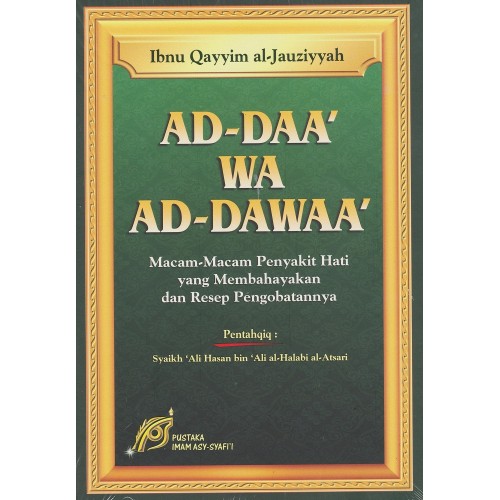
Ad-Daa’ Wa Ad-Dawaa’ (H/B)
Buku Ad-Daa’ wa ad-Dawaa’ adalah sebuah karya besar dan fenomenal di bidang akhlak, tarbiyah, dan tazkiyatunnufus. Penulisnya, Ibnu Qayyim al-Jauziyyah, adalah seorang ulama tersohor dan penulis buku berbobot yang hidup pada abad ke-8 H. Buku ini berbicara panjang lebar serta sempurna di berbagai masalah tarbiyah dan tazkiyatun-nufus, mulai dari pentingnya do’a bagi seorang hamba serta hubungan do’a dengan takdir.
Berbicara tentang macam-macam maksiat dan bahayanya bagi pelakunya, juga dosa-dosa dan pengaruh negatifnya secara langsung di dunia.
Berbicara pula tentang hukuman Allah terhadap hamba-Nya baik itu hukuman syar’i maupun qadari, qalbi maupun badani, duniawi maupun ukhrawi. Berbicara mengenai syirik dan macam-macamnya dalam ibadah, perbuatan, perkataan, kehendak, dan niat, serta syiriknya agama Nasrani, juga syirik dalam wasilah dan syafaat.
Berbicara seputar dosa-dosa besar, seperti kezhaliman, pembunuhan, dan zina beserta dampak-dampak negatifnya. Berbicara seputar pintu-pintu pembuka maksiat, diantaranya bisikan hati, pandangan mata, dan langkah kaki. Berbicara mengenai liwath (homoseks) dan menyetubuhi binatang; serta tentang cinta, tingkatan-tingkatannya, soal mabuk asmara dan masalah yang lain.
Anda akan dibuat terpesona oleh uraian-uraian penulis yang sangat dalam dan kuat, halaman demi halaman. Anda pun akan terpuaskan dari dahaga ilmu yang bermanfaat. Maka janganlah Anda lewatkan untuk segera memiliki buku ini dan menelaahnya.
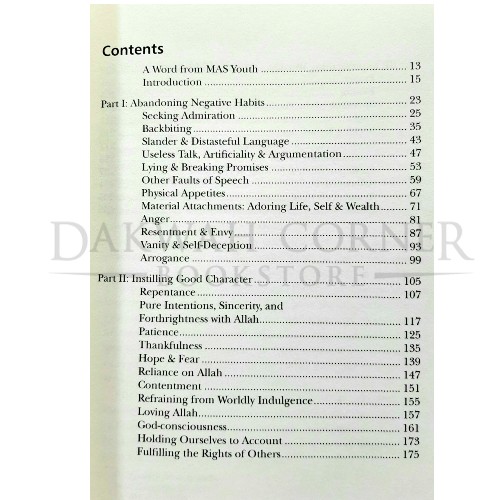
Rising Soul: A Guide To Personal Development
“The beauty of this volume lies in its simple presentation of self-development as a clear process with precise, achievable goals. Young believers and Islamic workers seeking to improve themselves will find this book an invaluable companion.”
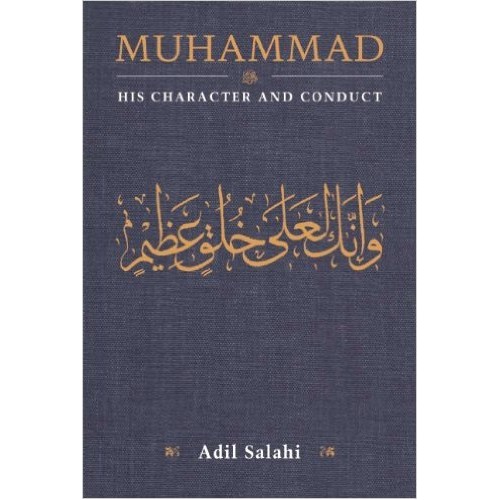
Muhammad His Character and Conduct
Seerah and Biographies
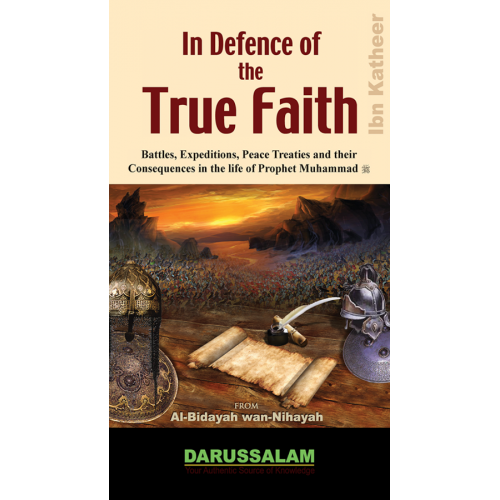
In Defence of the True Faith (H/B)
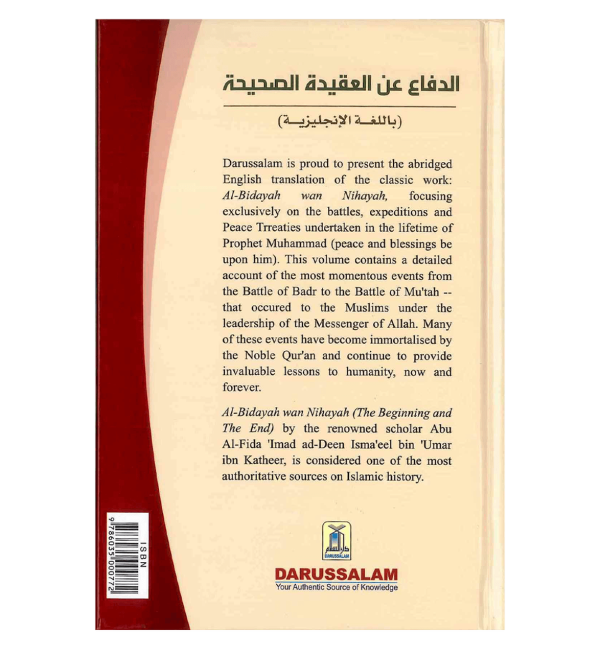
Darussalam is proud to present the abridged English translation of the classic work: Al-Bidayah wan Nihayah, focusing exclusively on the battles, expeditions and Peace Treaties undertaken in the lifetime of Prophet Muhammad (peace and blessings be upon him). This volume contains a detailed account of the most momentous events from the Battle of Badr to the Battle of Mu’tah -that occurred to the Muslims under the leadership of the Messenger of Allah. Many of these events have become immortalized by the Noble Qur’an and continue to provide invaluable lessons to humanity, now and forever.
Al-Bidayah wan Nihayah (The Beginning and The End) by the renowned scholar Abu Al-Fida ‘Imad ad-Deen Isma’eel bin ‘Umar ibn Katheer/Kathir, is considered one of the most authoritative sources on Islamic history.
There are no reviews yet.