

| Weight | 0.430 kg |
|---|---|
| Author | |
| Binding | Paperback |
| ISBN | 9781891229930 |
| Pages | 100 |
| Publisher | Al-Kitaab & as-Sunnah Publishing |
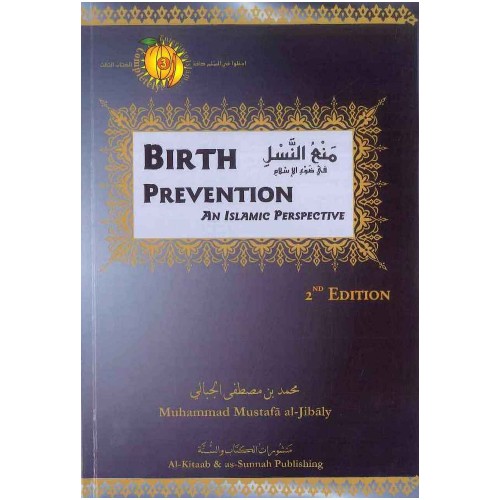
Birth Prevention an Islamic Perspective
RM26.00
Hurry up, Only 3 left.
Highlights:
somdn_product_page
Compare
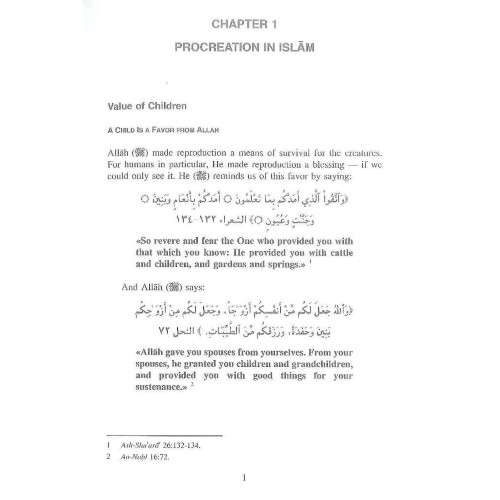
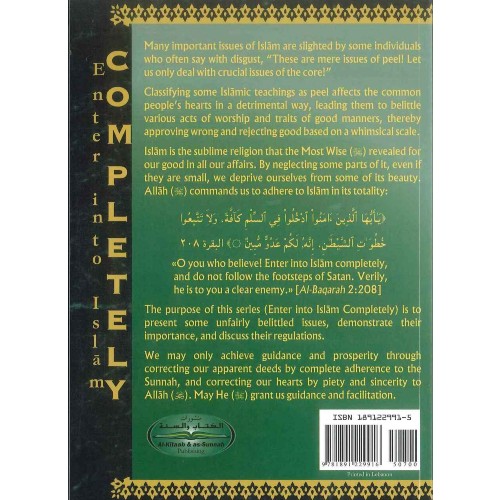
The purpose of this series, enter in to islam completely, is to present some unduly belittled issues, prove their value, and discuss their regulations. This book presents a comprehensive Islamic understanding of birth prevention and other related issues. It first establishes the Islamic view of procreations. This is followed by an overview of birth prevention methods, old and modern
Additional information
Reviews (0)
Be the first to review “Birth Prevention an Islamic Perspective” Cancel reply
You must be logged in to post a review.
Related Products


The Concise Presentation of the Fiqh of the Sunnah and the Noble Book
Highlights:
Written by Dr. Abdul-Azeem Badawi and translated by Jamal al-Din M. Zarabozo, The Concise Presentation of the Fiqh of the Sunnah and the Noble Book covers the fiqh of diverse topics like purity, prayer, fasting, zakah, pilgrimage, marriage, business transactions, foods, inheritance, criminal offenses, and jihad. Dr. Badawi relies only on the Quran and the Sunnah, making it an authentic Islamic book on fiqh and a collection of sound hadiths.
RM90.00


Islamic Rulings on Menstruation and Postpartum Condition
Highlights:
The birth of human being is a most amazing phenomenon. The physical cycles that the body of woman must endure in order to maintain this act of creation should be respected to the highest degree. Allah mentions that our mothers have born us with difficulty and struggle and because of this are due the highest respect. one among many of the difficulties that women must brave, are the doubts that these conditions present to the correct obervance of her religion. How is her fassting affected, how are her prayers affected, how is her ability to pursue her studies, and how are her conjugal relations affected by her ever changing physical condition in relation to her as the sole vessel of the birth of man. A really valuable publication by Darussalam for all Muslim woman to study
RM11.00


Having Fun The Halal Way Entertainment In Islam
5 ★
5 ★
1 Rating
5 ★
1
4 ★
0
3 ★
0
2 ★
0
1 ★
0
Highlights:
With the advent of technology, the entertainment industry has flourished and become immensely popular. Combine this with the exponential advances in technology, and the result is an increasing number of ways to amuse ourselves. As a result of such advances, Muslim react in a variety of manners towards entertainment. Some label entertainment as completely forbidden. This sometimes includes parents who say no to almost everything that their young ones deem to be ‘fun’, without providing them with suitable alternatives. Others, who do not want to take this extreme approach, fall into the trap of excessive use of – and even addiction to – various sources of entertainment, without any limits.
In Having Fun the Halal Way, Ismail Kamdar explores the teachings of Islam regarding entertainment. Drawing upon the Quran, the Sunnah and the understanding of the righteous scholars of Islam, he provides a detailed and balanced analysis of the topic. He not only explains the detriments of the current entertainment industry, but also suggests alternative means to have a good time with friends and family members.
RM18.00

A Guide to Male-Female Interaction
Highlights:
Are Muslim men allowed to interact with female students, and vice versa, in a virtual classroom? Can a Muslim woman pursue a professional career that necessitates her interaction with men? Is it appropriate for a woman to serve her husband’s guests? Do mixed wedding ceremonies comply with the Sharia? Read this bilingual book to find the answers and more!
RM56.00


Getting the Best Out of Hajj
Highlights:
The book provides a realistic view of Hajj as it is today, with detailed explanations of all the rites. It provides Figh related issues about Hajj, Salah and personal behaviour according to the Quran and Sunnah, to enable you to obtain the best value for your time spent in the holy cities. It also provides information and suggestions about planning for the journey, what to expect and how to survive, so you can depart with full confidence. This is a must have for all those planning to go on Hajj!
RM75.00


Fiqh Course: Tahaarah, Salaah & Janaa’iz
Highlights:
This course was compiled for English-speaking Muslims and is especially beneficial for new Muslims. It covers tahârah (purification), salâh (prayer) and janâ‘iz (funerals). It is set out in an easy-to-understand manner, citing evidence from the Qur’an and authentic hadiths. The aim of this book is to provide the reader with a correct, yet uncomplicated guide to the performance of the aforementioned acts of worship. Allah willing, it is the first in a series which will cover all aspects of worship and Islamic jurisprudence.
RM46.00

The Right to Education, Work and Welfare in Islam (P/B)
Highlights:
In The Right to Education, Work and Welfare in Islam Professor M.H. Kamali develops an Islamic perspective on three connected and complementary areas of rights and liberties. He urges that education is often a necessary ingredient of professional work even more so now than in earlier times when the range and variety of specialised knowledge were relatively limited. A person who acquires education, whether generally or at advanced levels of specialisation, is more likely to stand in a better position to enter the workforce and thus to contribute to the welfare of the community.
The author commences his discussions on education, work and welfare in Islam by focusing on how each is treated in the Qur’an; and follows this by the example of the Prophet and, after him, the Pious Caliphs who gave prominence to the education and welfare needs of people at times both of scarcity and affluence. Professor Kamali then moves forward to our time and discusses the right to education, the education of children, institutionalisation of learning, academic freedom and the debate between science and religion.
The section on work elaborates on the value of work, work ethics, workers’ and employers’ rights and responsibilities, and the role and responsibility of governments.
Finally, the section on welfare focuses on the importance in Islam of caring for those who are in need and the different forms of provision that can be made available by individuals, the state and charities.
RM63.00

The Pillars of Islam Made Easy – II Salah & Its Essential Conditions (H/B)
Highlights:
Salah is one of the five pillars on which the edifice of Islam rests. Most of us feel that we already know all there is about salah – the formal prayers of a Muslim. However, very few individuals actually do justice to it or derive any worldly or spiritual benefits from it.
Salah & Its Essential Conditions is an effort to detail the essential prerequiires of salah. Moreever, it takes a detailed look at its importance along with the different types of obligatory and voluntary prayers. It alsa presents an illustrated guide to help those who wish to learn or correct the performance of their prayers.
Inshallah, all those who wish to improve their salah will find plenty of help in this book whether they are looking for information on cleanliness and purify, locating the direction of qibla, improving their congregation during salah, making up for the missed salah, or joining acongregation when the imam has already sarted the salah, or joining a congregation when the imam has already started the salah. All in all, it is a relevant handbook on what the Prophet (saw) has described as the coolness of his eyes.
RM50.00


Fiqh According To The Quran & Sunnah (2 vol)
Highlights:
The complete set, ‘Al-Lubab Fee Fiqh As-Sunnah Wal-Kitab,’ contains all of the books of Islamic Fiqh and its chapters, accompanied by evidence and is presented in a clear and simple manner, in order that they may be understood by the young and the old, without blindly following any of the schools of Jurisprudence, but rather being subject to authentic proofs and following the most authoritative opinions, without fanatical adherence to any particular group. Rather the author agrees with each group when the truth is with them and contradicts them when they veer from that which is correct.
Fiqh is to achieve access to knowledge of that which is unclear through knowledge of that which is proven, so it is more specific than mere knowledge or learning. And fiqh is knowledge of the juristic law. It is said Faquha -A man has acquired understanding and so he has become a Faqeeh (A scholar of Islamic Jurisprudence); and it is said Faqiha – He has understood it, i.e he has attained understanding of it, and it is said Tafaqqaha – he has devoted himself to the acquisition of (Islamic) Knowledge and specialized in it. Fiqh has been a subject of contention among the scholars as well as layman throughout the history of Islam.
RM180.00

Shatibi’s Philosophy of Islamic Law (P/B)
Highlights:
Abu Ishaq al-Shatibi, who died in 1888, had sought an answer to the challenge posed by modernisation and change to Islamic law, by introducing maslahah, which forms the basis of his philosophy of Islamic law. In a fascinating way, the author leads us step by step to what he considers the true import of Shatibi’s views concerning jurisprudence.
RM41.00

Istihsan (P/B)
Highlights:
This work constitutes a critical analysis of classical and modern aspects of the concept of istihsan (juristic preference), an important principle in Islamic legal legislation throughout history. Although there has been many research works on the subject, it still requires further investigation on the role and nature of istihsan with regard to a combination of classical and modern approaches. Consisting of four chapters, the author begins by introducing some general principles of Islamic law, before discussing the history of istihsan during the time of the Prophet and his Companions. He also analyses the validity of istihsan as a source of law and discusses the differences among scholars on its method of implementation.
RM57.00


Should A Muslim Follow A Particular Madhhab?
Highlights:
In this book, the author has widely described the main principle of Taqleed. He says that Allah and Prophet Mohammed (SAW) has not ordered us to follow any opinions and interpretations. So there’s a possibility of being correct or incorrect in the opinions because there are many issues on which the Imams had different views and they explain them according to their own reasons and speculations, but the real and true Islam is based on the book (Quran) and Prophet’s Sunnah.
Allah says: “But no, by your Lord, they can have no Faith until they make you judge in all disputed matters between them, and find in themselves no resistance against your decision, and accept them with full submission.” And the prophet said: “I leave you with two things as long as you hold them tightly, you never go astray: they are the book of Allah and my Sunnah.” In this sense, the author has described the difference between different Madhahib (madhabs/mazhabs), and their views and urged to follow only the Quran and Sunnah.
RM11.00
Recently Viewed
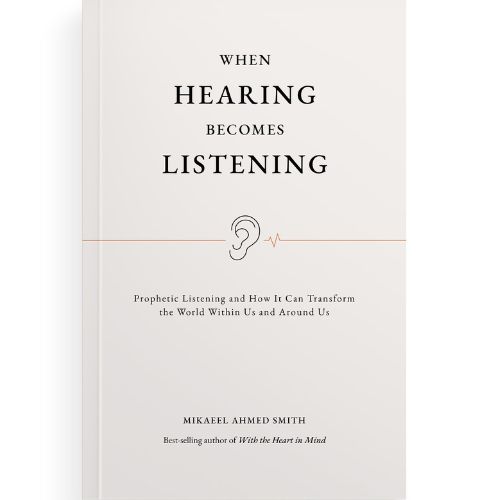
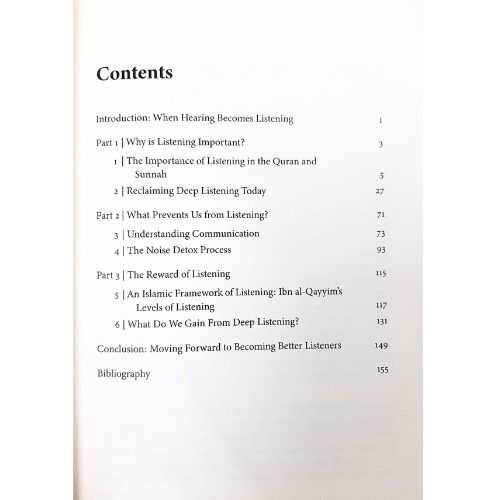
When Hearing Becomes Listening
Highlights:
This book picks up where With the Heart in Mind stopped, diving deeper into the primary tool that enabled the Prophet (s.a.w.) to be so influential and leave such a profound impact on the people around him. The premise is simple. If you wish to be listened to like the Prophet (s.a.w.), you must first learn to listen like the Prophet (s.a.w.).
RM95.00
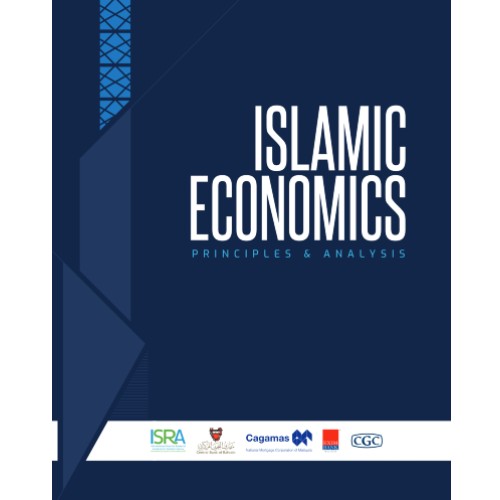
Islamic Economics : Principles & Analysis (P/B)
Highlights:
Economics is a social science that studies the behaviour and interactions of economic agents and analyses how economies work at the macro- and micro-levels. It studies production, distribution and consumption of goods and services, identifies economic problems and phenomena, and addresses economic questions from a positive perspective (what is) as well as a normative (how it should be) perspective. Islamic economics examines the same areas as its conventional counterpart. However, it involves the application of Sharīʿah to the different economic functions and issues. It is postulated that Islam offers a better approach compared to conventional economics in managing economic activities and solving economic and social issues.
RM180.00
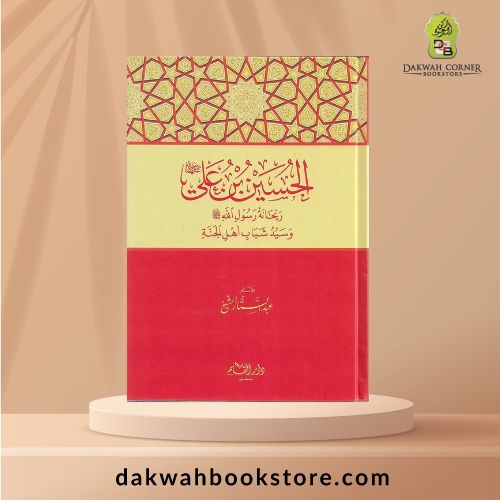
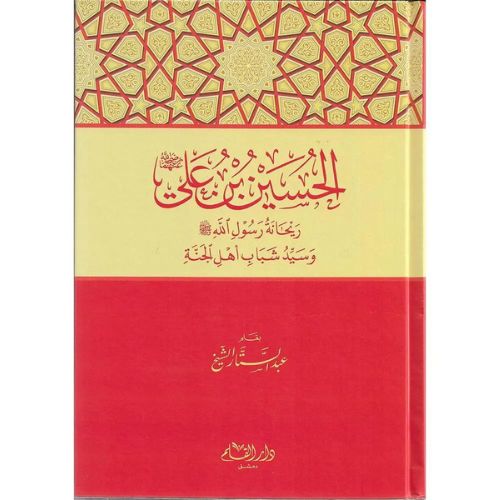
[SB] Al Hussein bin Ali R.A / الحسين بن علي رضي االله عنهما ريحانة رسول االله صلى االله عليه وسلم وسيد
Highlights:
عنوان الكتاب : الحسين بن علي : ريحانة رسول الله صلى الله عليه وسلم وسيد شباب أهل الجنة
RM135.00
RM21.00
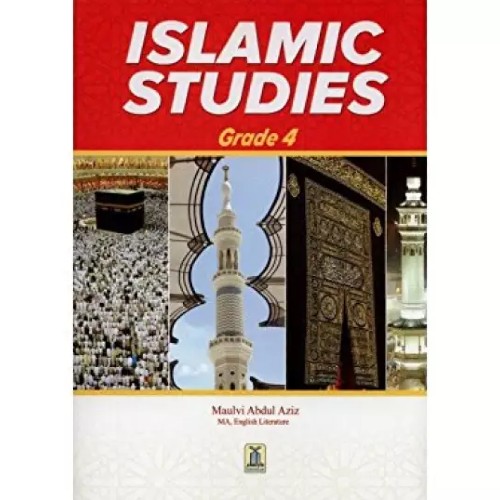
Islamic Studies Grade 4 – Darussalam
Highlights:
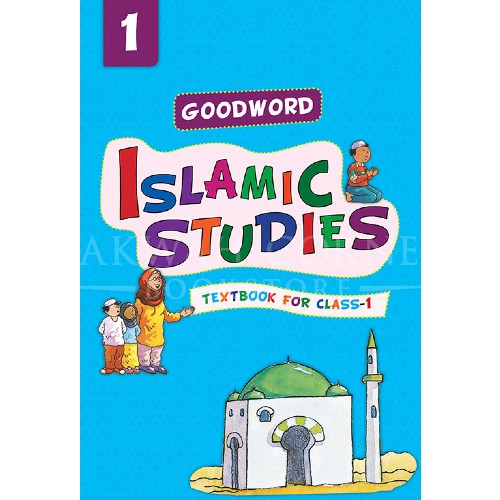
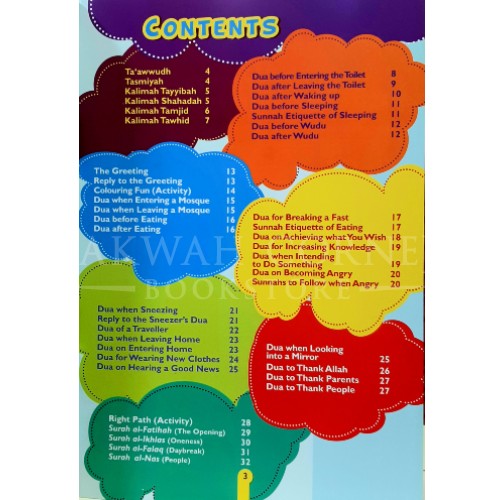
.The present series covers all areas of Islamic studies: Tafseer, Hadeeth, Tawheed, Fiqh, Seerah, and general etiquette relating to different areas and situations. Every effort has been made to ensure that the material presented in the series is authentic and most of the terms are presented in their original Arabic script, along with the transliteration and the translation of their meanings. This also applies the supplications which have to be memorized in their Arabic version. The aim re is to help the readers read the original text and understand its meaning. Each lesson is followed by exercises covering a question about the lesson.
RM110.00
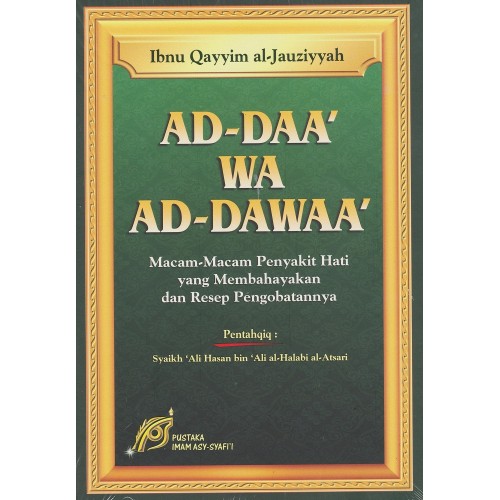
Ad-Daa’ Wa Ad-Dawaa’ (H/B)
Highlights:
Buku Ad-Daa’ wa ad-Dawaa’ adalah sebuah karya besar dan fenomenal di bidang akhlak, tarbiyah, dan tazkiyatunnufus. Penulisnya, Ibnu Qayyim al-Jauziyyah, adalah seorang ulama tersohor dan penulis buku berbobot yang hidup pada abad ke-8 H. Buku ini berbicara panjang lebar serta sempurna di berbagai masalah tarbiyah dan tazkiyatun-nufus, mulai dari pentingnya do’a bagi seorang hamba serta hubungan do’a dengan takdir.
Berbicara tentang macam-macam maksiat dan bahayanya bagi pelakunya, juga dosa-dosa dan pengaruh negatifnya secara langsung di dunia.
Berbicara pula tentang hukuman Allah terhadap hamba-Nya baik itu hukuman syar’i maupun qadari, qalbi maupun badani, duniawi maupun ukhrawi. Berbicara mengenai syirik dan macam-macamnya dalam ibadah, perbuatan, perkataan, kehendak, dan niat, serta syiriknya agama Nasrani, juga syirik dalam wasilah dan syafaat.
Berbicara seputar dosa-dosa besar, seperti kezhaliman, pembunuhan, dan zina beserta dampak-dampak negatifnya. Berbicara seputar pintu-pintu pembuka maksiat, diantaranya bisikan hati, pandangan mata, dan langkah kaki. Berbicara mengenai liwath (homoseks) dan menyetubuhi binatang; serta tentang cinta, tingkatan-tingkatannya, soal mabuk asmara dan masalah yang lain.
Anda akan dibuat terpesona oleh uraian-uraian penulis yang sangat dalam dan kuat, halaman demi halaman. Anda pun akan terpuaskan dari dahaga ilmu yang bermanfaat. Maka janganlah Anda lewatkan untuk segera memiliki buku ini dan menelaahnya.
RM80.00
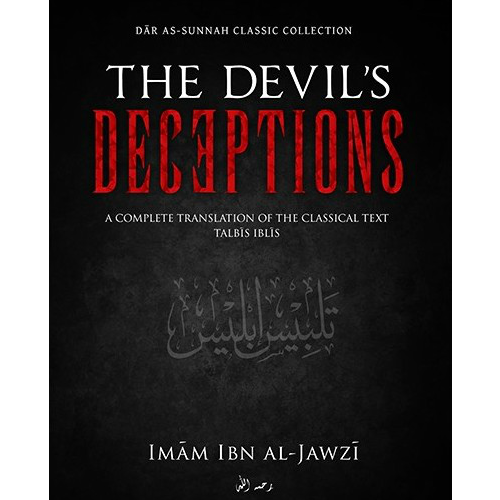
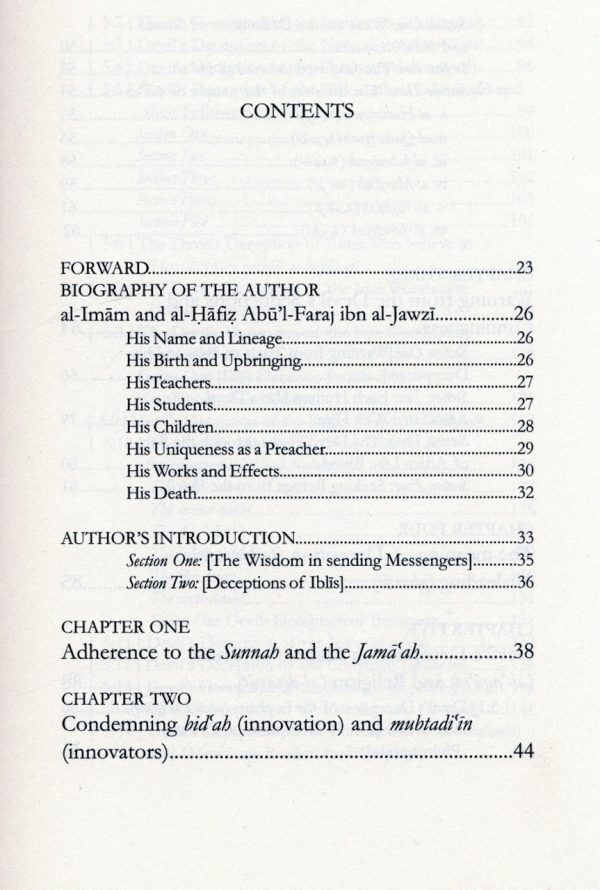
The Devil’s Deceptions
Highlights:
Imam Ibn Al-Jawzi It is from enmity and hopelessness of the devil that his endeavour to misguide mankind from the Path of Allah will persist. This misguidance takes many shades and forms; be it from planting seeds of doubt, or giving rise to deviant ideas antithetical to the sacred teachings of Islam, and essentially becoming entangled within regressive intellectual and rhetorical discourses.
The Ummah has suffered varying levels of deviation, some of which remain prevalent today, while more continue to be uncovered – and such is the impact of delusive plottings of the devil and his allies. This book is the sixth instalment from Dar as-Sunnah of the illustrious Imam, Abu’l-Faraj Ibn Jawzi. Being a complete translation of his well-known and prized work, Ibn Jawzi enumerates within it, many of the mechanisms and modus operandi used by the devil in deceiving and leading mankind away from the Straight Path.
It is of particular value and importance because only by unearthing and accentuating some of the traps of the devil, can mankind avoid them as well as navigate others away from falling prey to his harm. Speaking about the devil and his plotting, the author wrote that, “he was only able to do so while creeping during the night of ignorance. Had the dawn of knowledge shone on him, he would have been exposed.
Thus I decided to warn from his plots… for identifying evil is a form of warning from it.” This translation of Tablees Iblees will provide important analysis in developing self-awareness and critical thinking to ward off many deceptions of the devil, which have plagued mankind from the time of Adam. For such reasons alone, this work is a valuable addition to the scholarly discourse it presents to the English speaking world.
RM220.00
I Learn To Say Subhanallah
Highlights:
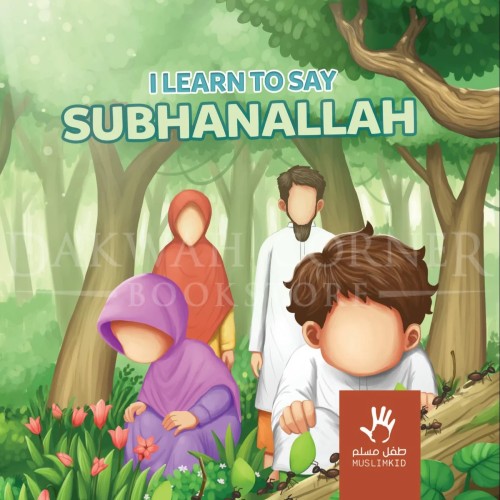
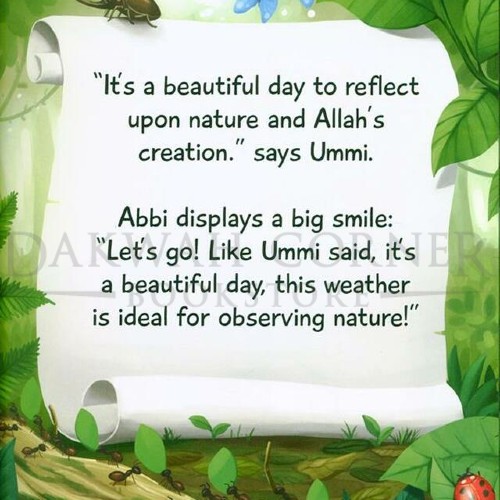
Discover a selection of captivating illustrations, accompanied by basic, but important concepts for young Muslim children. I Learn to Say SubhanAllah is the second issue of the “I Learn to Say” series. Throughout this second issue your child will learn when to say SubhanAllah through a beautiful story about Muhammad and Zaynab. This hardcover, 60-page book explains when and why we say SubhanAllah in a fun way. Take your time to read this story with your child, and nurture in them the importance of saying SubhanAllah. The characters in the book are expressionless to help develop young and curious imaginations.
RM50.00


A Guide to Salah (Prayer) (P/B)
5 ★
5 ★
1 Rating
5 ★
1
4 ★
0
3 ★
0
2 ★
0
1 ★
0
Highlights:
This book is the result of direct research into the Sunnah of Prophet Muhammad saw and makes numerous references to the original sources. It contains all the essential details of salah without being too bulky or complicated, thus making it an ideal reference book either at home or while travelling.
A clear and concise explanation on how to pray. Also gives a detailed description of the preliminaries to salah, and different types of salah, with easy-to-follow illustrations.
RM16.00
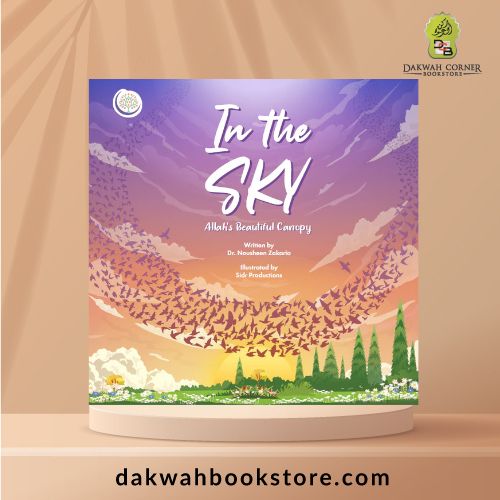

In The Sky (P/B)
Highlights:
In the Sky takes young readers on a journey above the clouds to discover Allah’s wonders through the wings of eagles, sparrows, doves, parrots, owls, bats, butterflies, and even the special Hudhud bird from the Qur’an. Each page pairs lyrical rhymes with vibrant illustrations, reminding children that every feather, flight, and breeze is a sign of Allah’s mercy and wisdom. With Qur’anic reflections and gentle lessons on trust, gratitude, and faith, this beautifully crafted book inspires children to look up, whisper SubhanAllah, and remember that just as Allah guides the birds through the sky, He is always guiding and protecting us too.
RM20.00 RM35.00
There are no reviews yet.