


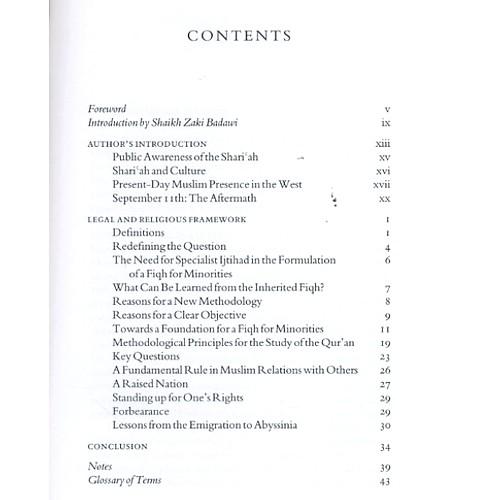

Towards a Fiqh for Minorities is an important subject and a much needed contribution to an area of fiqh that has become essential for the wellbeing and development of Muslim communities living in the West. The author stresses that the problems of Muslim minorities can only be tackled with a fresh juristic vision based on the principles, objectives, and higher values of the Qur’an in conjunction with the ultimate aims and intents (maqasid) of the Shariah. In essence, Dr. Al-Alwani s paper is a call for Muslim minorities to have a sense of themselves as citizens and develop a positive, confident view of their place and value in society, moving away from notions of immigrant status and governed by a humanistic vision focusing on the betterment of society.
Towards A Fiqh For Minorities: Some Basic Reflections
$7.95
| Weight | 0.40 kg |
|---|---|
| Dimensions | 22.86 × 15.24 cm |
| Author | |
| Binding | Paperback |
| ISBN | 9781565643529 |
| Pages | 45 |
| Publisher |
Be the first to review “Towards A Fiqh For Minorities: Some Basic Reflections” Cancel reply
You must be logged in to post a review.
Related Products

Shatibi’s Philosophy of Islamic Law (P/B)
Abu Ishaq al-Shatibi, who died in 1888, had sought an answer to the challenge posed by modernisation and change to Islamic law, by introducing maslahah, which forms the basis of his philosophy of Islamic law. In a fascinating way, the author leads us step by step to what he considers the true import of Shatibi’s views concerning jurisprudence.


Getting the Best Out of Hajj
The book provides a realistic view of Hajj as it is today, with detailed explanations of all the rites. It provides Figh related issues about Hajj, Salah and personal behaviour according to the Quran and Sunnah, to enable you to obtain the best value for your time spent in the holy cities. It also provides information and suggestions about planning for the journey, what to expect and how to survive, so you can depart with full confidence. This is a must have for all those planning to go on Hajj!


Principles of Islamic Jurisprudence (2nd Revised Edition)
This book offers a detailed presentation of the theory of Muslim law (usul al-figh). Often regarded as the most sophisticated of the traditional Islamic disciplines, Muslim jurisprudence is concerned with the way in which the rituals and laws of religion are derived from the Qur’an and the Sunna – the precedent of the Prophet. Revelation, which is given to man to restore unity and help him achieve a just and devout order in society as well as in the soul, must be interpreted so as to render it practicable in every culture, while not betraying its spirit and immutable provisions. To achieve this, additional sources of legal authority are recognized, including consensus (ijma), analogical deduction (qiyas), public interest (maslaha) and local customary precedent (urf). In employing these, the jurist guards the five principles which it is the purpose of Islamic law to uphold, namely, the right to life, sound mind, property, lineage and religion.

Islamic Rules of Order (P/B)
Organizations must have rules of order to facilitate their debate and to fill in the procedures not detailed by their constitutional documents. While most American organizations are content to operate by Robert’s Rules of Order, Muslim organizations have often wrestled with questions over whether the rules of order systemized by a Western military figure are in accord with the Qur’an and the Sunnah.
This book tackles the matter directly and takes into account the Qur’an, the sunnah, Islamic manners and the history of Islamic consultation and leadership to provide a simple, practical guide to organizational procedure that can be incorporated into the governance of Muslim organizations. The book includes advice on writing bylaws and on complying with the best practices of the U.S. Dept. of Justice in a way that is Islamically authentic, transparent, and accountable. It provides a basic starting point for any Muslim organization while allowing for flexibility so that organizations may make any variations they require within their own bylaws and constitution, so that it can accommodate differing schools of thought on Islamic law. In its discursive approach it is an essential primer for understanding the value of rules of order and the Islamic context for their application. The Islamic Rules of Order has been adopted as the rules of order of the Association of Muslims Social Scientists.


Hajj & Umrah (Pocket Guide) – English Version
A useful pocket guide that includes the rites of Umrah,Hajj, and visiting Madinah.

Forensic Psychiatry In Islamic Jurisprudence (P/B) (IBT)
This is the first book in Forensic Psychiatry that focuses on the application of psychiatry to legal issues connected to Islamic jurisprudence. It gives contemporary psychiatry in any Islamic country a broad spectrum of tools to work with, enabling the utilization of options specific to particular societal and cultural norms. This book will appeal to both the general as well as the academic reader.


Should A Muslim Follow A Particular Madhhab?
In this book, the author has widely described the main principle of Taqleed. He says that Allah and Prophet Mohammed (SAW) has not ordered us to follow any opinions and interpretations. So there’s a possibility of being correct or incorrect in the opinions because there are many issues on which the Imams had different views and they explain them according to their own reasons and speculations, but the real and true Islam is based on the book (Quran) and Prophet’s Sunnah.
Allah says: “But no, by your Lord, they can have no Faith until they make you judge in all disputed matters between them, and find in themselves no resistance against your decision, and accept them with full submission.” And the prophet said: “I leave you with two things as long as you hold them tightly, you never go astray: they are the book of Allah and my Sunnah.” In this sense, the author has described the difference between different Madhahib (madhabs/mazhabs), and their views and urged to follow only the Quran and Sunnah.


The Concise Presentation of the Fiqh of the Sunnah and the Noble Book
Written by Dr. Abdul-Azeem Badawi and translated by Jamal al-Din M. Zarabozo, The Concise Presentation of the Fiqh of the Sunnah and the Noble Book covers the fiqh of diverse topics like purity, prayer, fasting, zakah, pilgrimage, marriage, business transactions, foods, inheritance, criminal offenses, and jihad. Dr. Badawi relies only on the Quran and the Sunnah, making it an authentic Islamic book on fiqh and a collection of sound hadiths.


Having Fun The Halal Way Entertainment In Islam
With the advent of technology, the entertainment industry has flourished and become immensely popular. Combine this with the exponential advances in technology, and the result is an increasing number of ways to amuse ourselves. As a result of such advances, Muslim react in a variety of manners towards entertainment. Some label entertainment as completely forbidden. This sometimes includes parents who say no to almost everything that their young ones deem to be ‘fun’, without providing them with suitable alternatives. Others, who do not want to take this extreme approach, fall into the trap of excessive use of – and even addiction to – various sources of entertainment, without any limits.
In Having Fun the Halal Way, Ismail Kamdar explores the teachings of Islam regarding entertainment. Drawing upon the Quran, the Sunnah and the understanding of the righteous scholars of Islam, he provides a detailed and balanced analysis of the topic. He not only explains the detriments of the current entertainment industry, but also suggests alternative means to have a good time with friends and family members.


Funerals Regulations and Exhortations (H/B)
Our soul inevitably follows a route starting from birth, passing through death, and ending with our resurrection in the next life. The inevitable journey discusses over a sequence of titles: sickness, inheritance, funerals, Life in Barzakh and so on…

Hajj & Umrah And Visitors (H/B)
Rites and Selected Etiquettes for those intending to Perfom Hajj & Umrah and Visitors In this book the author calls attention to the most important things that those who intend to perform Hajj, Umrah or Visiting the Prophets Mosque in Medinah must have as provisions. The author has made his work brief and arranged its topics according to their priorities. the author mentions a considerable number of sayings of the people of knowledge and calling the attention of the reader to some important matters.


Smoking Intoxicants & Narcotics (P/B)
This book deals with the epidemic of smoking, which enslaves many of today’s Muslims, and which is aggravated by that most victims belittle its dangers and deny its prohibition.
This book includes a discussions of intoxicants, establishing the prohibition of various practices associated with them, as well as penalties (in both lives) for those who partake in them.
This book also includes a discussion of narcotics, with an overview of marijuana and qaat (or khat). Based on their established effects and harms, we conclude that narcotics are strongly prohibited, except in very limited medical settings.
This book, we hope, will provide many Muslims with guidance toward a healthier, cleaner and worthies Islamic personality. My Allah grant us guidance and facilitation.
Recently Viewed
Authentication of Hadith: Redefining the Criteria (IIIT)
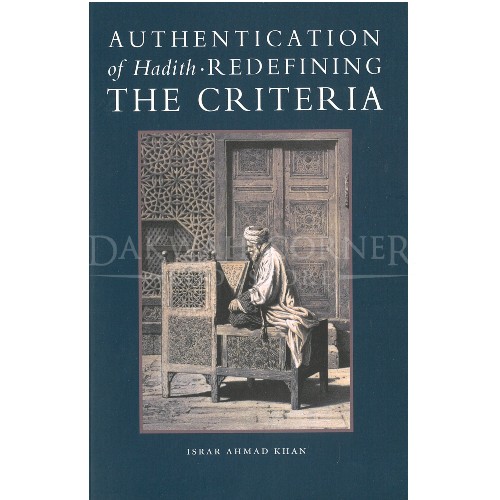
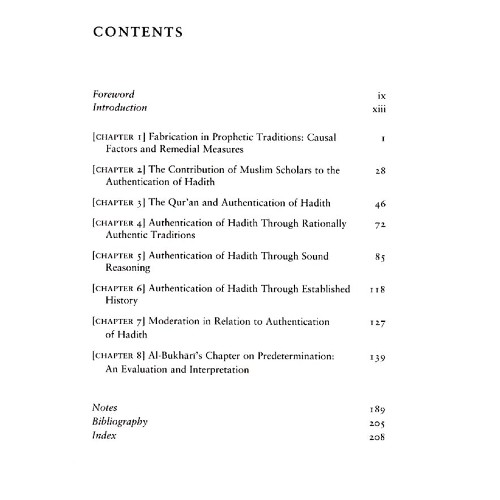
In today’s complex and volatile world the consequences of relying on fraudulent and counterfeit Hadith to legitimise extremist behaviour, issue violent fatwas, and justify blatant abuse, particularly of women, is not only far too easy but in fact dangerous. Israr Khan addresses the sensitive topic of Hadith authentication, focusing on the criteria adopted by classical scholars to maintain that concentration on the continuity and accuracy of the chain of narrators, rather than the textual content of Hadith, has led to particular Hadith being included which either contradict other Hadith directly, project the Prophet (SAAS) in an uncharacteristic light, or do not reflect and/or conflict with the teachings of the Qur an. The study traces in careful detail the historical development of the oral and written traditions, as well as the many targeted attempts at fabrication that took place, critiquing in methodical detail certain Hadith which have come to be widely accepted as authentic. The prominent collections we have today, were made possible by the development of the science of Hadith criticism, and Muslim scholars deserve deep appreciation for their painstaking work, as well as their invaluable contribution towards preserving the Hadith literature to the best of their ability. However, insists the author, the process is ongoing, and the closed door policy which currently surrounds Hadith authentication needs to be carefully reexamined.
A Long Jihad : My Quest For The Middle Way
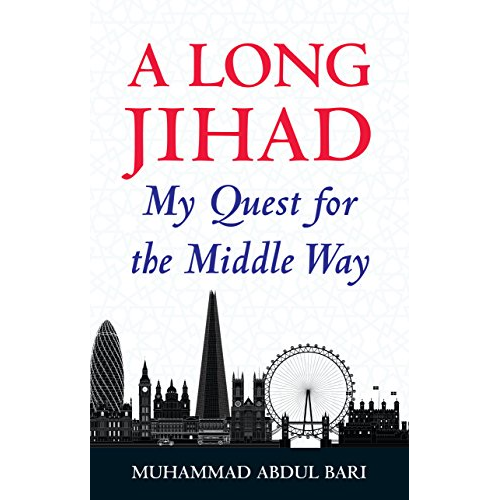
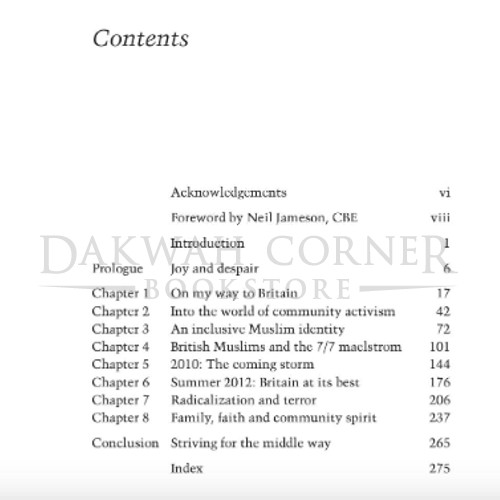
In this memoir, Dr Muhammad Abdul Bari asks us to look beyond the extremism and violence that all too often defines the Muslim community toward those, like himself, navigating a middle-way life.
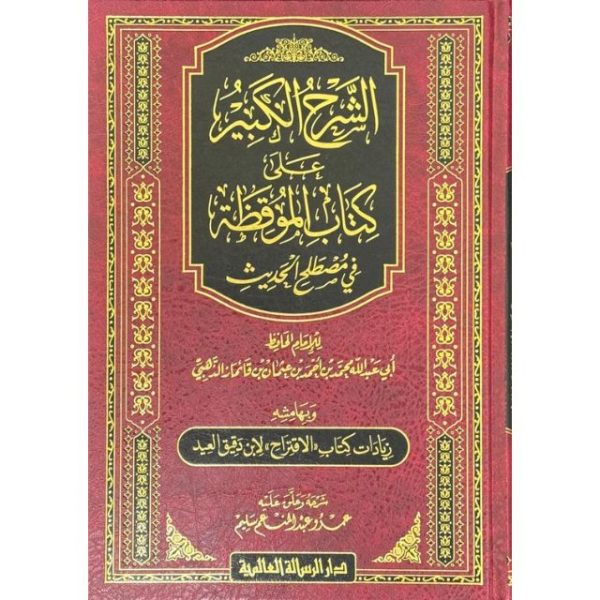
[AUH]Al-Sharḥ al-Kabīr ʿAlā al-Mawqiẓah / الشرح الكبير علي الموقظة
“الشرح الكبير على كتاب الموقظة” هو شرح موسع لمتن “الموقظة في علم مصطلح الحديث” للحافظ الذهبي. قام بإعداده وتحقيقه والتعليق عليه الباحث والمحقق عمرو عبد المنعم سليم
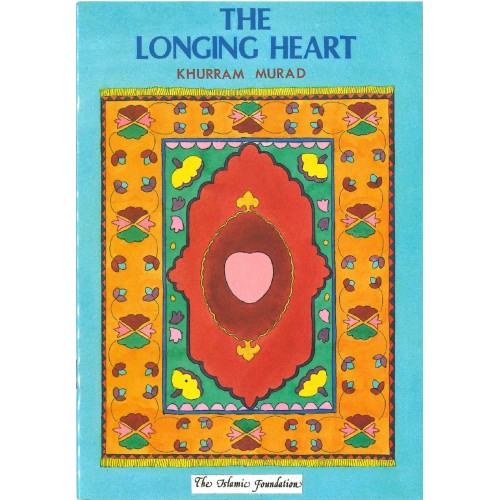
The Longing Heart : Story of Abu Dhar (P/B)
This is the story of a young man who longed to meet the new Prophet who had announced God’s message to the people of Makkah.
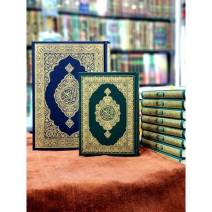
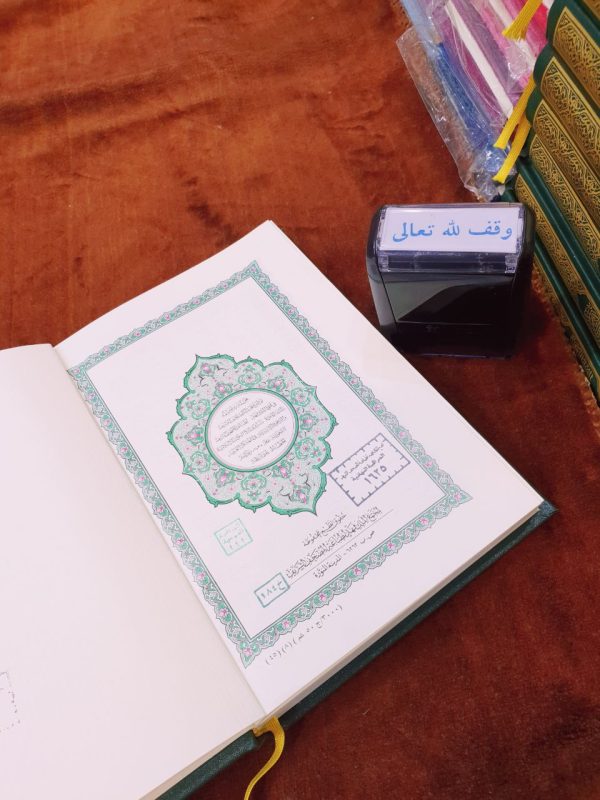
Mushaf Waqaf in Makkah Project
Mushaf Waqaf in Makkah Project
There is no doubt that rewards are multiplied at certain times and places as the Prophet (PBUH) have mentioned in many authentic Hadith. For example, the rewards of good deeds are doubled in Ramadhan and on the first 10 days of Dhul Hijjah, and prayers in the two Holy Mosque of Makkah are multiplied thousand folds.
We have noticed the interest of Muslim pilgrims and visitors since the ancient times in taking this opportunity of doubling their rewards throughout their stay in the Holy land of Makkah based on this principle. They have engaged in recitations of the Qur’an and pondering upon it, performing voluntary tawaf, offering voluntary prayers, doing extra charity works and other acts of worship prescribed by God Almighty.
Among the noble deeds by Pilgrims is the endowment of mushaf in Arabic as well as its translations in the Holy Mosque and the Prophet’s Mosque, taking advantage of the Muslims’ preoccupation with the Book of Allah during the period while seeking the satisfaction of their Creator in the purest spot on the globe.
Dawah Corner Bookstore Makkah branch is now introducing its new service of the endowment of the Mushaf in the Holy Mosque and the Prophet’s Mosque via an e-gateway in accordance with the regulations prescribed by the affairs of the Two Holy Mosques:
1- The Qur’an should be printed from King Fahd Complex in Madinah
2 – and to be placed in the places reserved for the Qur’an.
3 – with a clear seal (Waqf Lillah).
Now with this new e-service, everyone can perform the endowment of Mushaf in the Holy Mosque and the Prophet’s Mosque whenever they want and from wherever they are. Dawah Corner Bookstore will handle all the process onsite on your behalf and provide you with photographs and documents according to your needs for your record and for accountability purposes.
Simply log into our website, www.dakwahbookstore.com to choose your preferred Mushaf type and its quantity. After checking out, you will receive the details of the transaction in your mailbox. Please note that the price of the Qur’an Mushaf will be adopted at the market value at the time of the transaction.
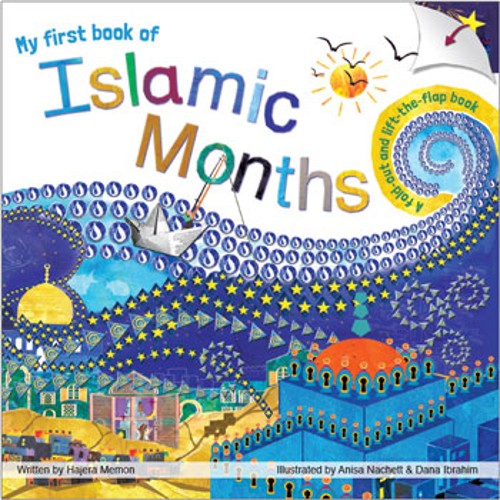
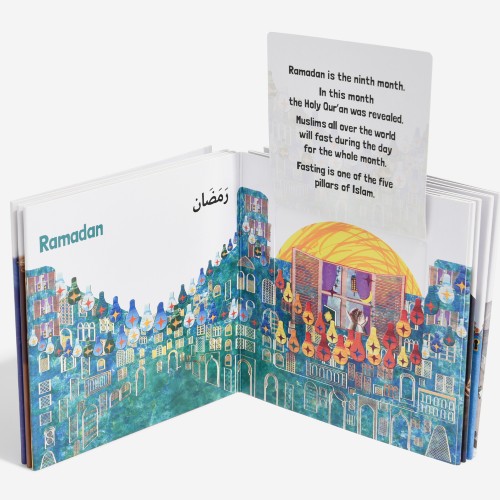
My First Book of Islamic Months
A Special Gift for Ramadan & Eid
Count your way through the Islamic months with this beautifully illustrated fold-out, lift-the-flap book.
There are no reviews yet.